Choosing a refrigerator with flexible storage means deciding what kind of flexibility will make a difference in your kitchen: a compartment that changes from fridge to freezer, adjustable shelves, or a compact layout that fits a tight room. My strongest all-around pick is the Kenmore 25.6 cu. ft. four-door refrigerator, because its FlexSpace drawer can serve as either a refrigerator or freezer while the main compartments handle a full grocery load. For more total room and an added ice maker, the Midea 29.3 cu. ft. French door refrigerator is a better match, though its standard-depth design needs clearance. The Midea 3.5 cu. ft. convertible chest freezer brings mode-changing flexibility to a garage or utility space, but it cannot replace a full-size refrigerator for most households.

Get home appliances delivered free with Prime
- Fast, free delivery on millions of items
- Prime Video, Amazon Music and more included
- Member-only deals all year
I’ve ranked these options by how usefully they adapt to different spaces and storage needs, not by capacity alone. The Kenmore offers the most versatile everyday layout; the large Midea prioritizes capacity and ice; and the two smaller models solve specific space problems. Their tradeoffs range from limited capacity to manual defrosting, so the right choice depends on whether you need a primary kitchen appliance, a supplemental cold-storage unit, or a compact refrigerator.
Complete the kit


Key Takeaways
- The Kenmore’s FlexSpace drawer switches between refrigerator and freezer use, making it the most adaptable primary kitchen option in this lineup.
- The Midea 29.3 cu. ft. model offers the most listed capacity and a dual ice maker, but its standard-depth cabinet needs more clearance than a counter-depth design.
- The Midea 3.5 cu. ft. chest unit changes between refrigerator and freezer modes and is designed for garages, but its small volume suits supplemental storage rather than a full household.
- The 7.5 cu. ft. compact refrigerator has a separate top freezer and reversible-door flexibility, but its manual-defrost system adds upkeep.
- These products solve different storage problems: compare intended location, usable capacity, and the kind of flexibility before choosing by headline features.
| Kenmore 25.6 cu. ft. 4-Door French Door Refrigerator, Fingerprint-Resistant Stainless Steel |  | Best Overall: convertible everyday storage | Capacity: 25.6 cu. ft. | Configuration: Four-door French door | Flexible compartment: FlexSpace drawer converts between refrigerator and freezer | VIEW LATEST PRICE | See Our Full Breakdown |
| Midea MRF29D6AST 29.3 Cu. Ft. French Door Smart Refrigerator, Stainless Steel |  | Best for Maximum Listed Capacity | Capacity: 29.3 cu. ft. | Configuration: French door, two doors | Installation: Freestanding | VIEW LATEST PRICE | See Our Full Breakdown |
| Midea 3.5 cu. ft. Convertible Chest Freezer with LED Light | 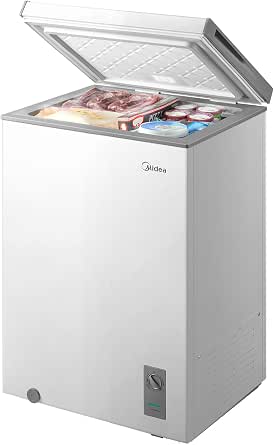 | Best Garage or Utility-Room Convertible | Capacity: 3.5 cu. ft. | Temperature modes: Refrigerator and freezer | Operating range: 38°F–110°F in refrigerator mode; 0°F–110°F in freezer mode | VIEW LATEST PRICE | See Our Full Breakdown |
| 7.5 Cu. Ft. Compact Double-Door Refrigerator with Top Freezer |  | Best Compact Pick for Small Rooms | Capacity: 7.5 cu. ft. | Configuration: Two-door top freezer | Dimensions: 55.1 in. H × 21.7 in. W × 20.5 in. D | VIEW LATEST PRICE | See Our Full Breakdown |
| refrigerators with flexible storage | Capacity | Configuration | Dispenser | Installation |
|---|---|---|---|---|
| Kenmore 25.6 cu. ft. 4-Door Fr | 25.6 cu. ft. | Four-door French door | External filtered water and crushed or cubed ice | — |
| Midea MRF29D6AST 29.3 Cu. Ft. | 29.3 cu. ft. | French door, two doors | Water and ice | Freestanding |
| Midea 3.5 cu. ft. Convertible | 3.5 cu. ft. | — | — | Freestanding |
| 7.5 Cu. Ft. Compact Double-Doo | 7.5 cu. ft. | Two-door top freezer | — | — |
More Details on Our Top Picks
Kenmore 25.6 cu. ft. 4-Door French Door Refrigerator, Fingerprint-Resistant Stainless Steel
The Kenmore 25.6 cu. ft. four-door refrigerator takes the top spot because its flexibility is built into a full-size kitchen layout rather than being limited to an add-on appliance. Its FlexSpace drawer converts between refrigerator and freezer use, giving households a way to adapt when chilled drinks, party platters, or frozen food need more room. That makes it more useful as a primary refrigerator than the Midea chest freezer, whose whole compartment also changes modes but offers only 3.5 cu. ft. of capacity.
Storage organization adds to its case. Four adjustable glass shelves, six door shelves including gallon-size bins, three crisper drawers, and a two-tier freezer create several ways to separate groceries. The dual evaporators and Multi-Flow Air System are intended to support consistent cooling across compartments, while Accela Chill and Accela Freeze provide named rapid-cooling functions. I would treat those as useful cooling features, not proof of a particular food-storage outcome.
The external filtered water and ice dispenser is convenient for frequent use, and the listed ice output is up to 4.5 pounds per day. But that convenience comes with a planning cost: the dispenser and four-door configuration need enough surrounding access. The supplied description does not give overall dimensions, so I would verify the appliance opening and clearance requirements before choosing it. Compared with the Midea 29.3 cu. ft. model, the Kenmore has less listed total capacity but a more clearly specified adjustable storage system and a convertible drawer. It is my strongest pick for households that want one appliance to handle several kinds of everyday storage without moving to a separate chest unit.
Pros:- FlexSpace drawer changes between refrigerator and freezer use.
- Four adjustable shelves, three crispers, and six door shelves support varied grocery organization.
- Dual evaporators and Multi-Flow Air System support compartment cooling.
- External filtered dispenser provides water and crushed or cubed ice.
Cons:- Overall dimensions are not specified in the supplied product details.
- External dispenser and four-door layout require careful access and clearance planning.
- The convertible drawer adds flexibility but does not make the entire refrigerator convertible.
Best for: Households seeking a full-size primary refrigerator with a compartment that can switch between refrigerator and freezer use, plus multiple drawers and adjustable shelves.
Not ideal for: Buyers who need published overall dimensions before checking a tight opening, prefer a simpler door layout, or want maximum listed capacity over a convertible drawer.
- Capacity:25.6 cu. ft.
- Configuration:Four-door French door
- Flexible compartment:FlexSpace drawer converts between refrigerator and freezer
- Shelving and drawers:4 adjustable glass shelves; 3 crisper drawers
- Door storage:6 door shelves, including gallon-size bins
- Cooling:Dual evaporators, Multi-Flow Air System, Accela Chill, Accela Freeze
- Dispenser:External filtered water and crushed or cubed ice
- Energy certification:ENERGY STAR
Our verdict“I rank the Kenmore first for its combination of full-size everyday organization and a genuinely adaptable drawer, provided its unlisted dimensions fit the kitchen.”
Midea MRF29D6AST 29.3 Cu. Ft. French Door Smart Refrigerator, Stainless Steel
If the main priority is room for a large grocery shop, the Midea MRF29D6AST offers the largest stated capacity in this group at 29.3 cu. ft. It uses a French door layout and includes a water-and-ice dispenser, plus a dual ice maker. Compared with the Kenmore, it lists 3.7 cu. ft. more total capacity and a second ice maker, which may suit a busy household that values volume and ice access over a specifically described convertible drawer.
That distinction matters for a flexible-storage roundup. The supplied information does not describe an adjustable-temperature compartment, convertible zone, adjustable shelving, or drawer arrangement for this Midea. Its flexibility is therefore mainly about having more overall room in a familiar French door form, rather than changing how a section operates. The Kenmore is the stronger choice if adapting chilled and frozen capacity is the central need; this Midea makes more sense when the household simply needs a larger stated interior and a dual ice-maker setup.
The model is freestanding, standard depth, and has LED interior lighting, a fingerprint-resistant finish, and a door alarm. The alarm can help alert users when a door is left open, while LED lighting makes contents easier to see. Its standard-depth cabinet may require more clearance than a counter-depth refrigerator, so I would check the kitchen layout instead of assuming it will sit flush with surrounding cabinets. The product details do not provide dimensions or a detailed interior organization breakdown, which makes fit and shelf planning harder to evaluate from the supplied specifications alone.
Against the Kenmore, this Midea offers more capacity but less documented storage adaptability. Against the 7.5 cu. ft. compact refrigerator, it is clearly intended for a full kitchen rather than a dorm, office, or small apartment corner. I’d choose it for the roomy interior and ice-making features, while skipping it if a configurable drawer or published fit measurements are non-negotiable.
Pros:- Largest stated capacity in this comparison at 29.3 cu. ft.
- Dual ice maker and water-and-ice dispenser offer multiple ice and water access points.
- Fingerprint-resistant finish and LED interior lighting are practical everyday features.
- Door alarm can alert users when the refrigerator door is left open.
Cons:- Standard-depth design may need more clearance than a counter-depth refrigerator.
- The supplied details do not identify a convertible temperature zone or adjustable shelving.
- Overall dimensions and detailed interior organization are not specified here.
Best for: Households that need the largest stated capacity in this roundup and want a French door refrigerator with water, ice, and a dual ice maker.
Not ideal for: Buyers who need a documented convertible compartment, detailed shelf and drawer specifications, or a compact or counter-depth fit.
- Capacity:29.3 cu. ft.
- Configuration:French door, two doors
- Installation:Freestanding
- Depth:Standard depth
- Ice maker:Dual ice maker
- Dispenser:Water and ice
- Interior lighting:LED
- Additional features:Fingerprint-resistant finish; door alarm
Our verdict“I’d choose this Midea over the Kenmore for greater listed capacity and dual ice-making, but not when flexible compartment settings are the deciding factor.”
Midea 3.5 cu. ft. Convertible Chest Freezer with LED Light
The Midea chest freezer is the most direct option here for buyers who want to change the purpose of a cold-storage appliance: its 3.5 cu. ft. interior switches between freezer and refrigerator modes. It is designed for garage and other non-climate-controlled settings, with stated operating ranges of 38°F to 110°F in refrigerator mode and 0°F to 110°F in freezer mode. That makes it a distinct choice from the Kenmore, whose convertible feature is a drawer within a full-size refrigerator rather than a whole appliance that can be reassigned.
This format works well as a supplemental cold-storage unit. A household might use it for freezer overflow, then switch to refrigerator mode when additional chilled storage is needed. The removable basket helps separate frequently accessed items from the larger chest interior, but a basket is not the same as the shelves and doors found in the upright Kenmore or compact top-freezer model. Chest storage can make items lower down less convenient to reach, especially when the interior is full.
Its compact 17.6-inch depth, 21.5-inch width, and 33.5-inch height make the footprint relatively modest among these options, though it still requires a freestanding location. The product details state up to 48 hours of frozen-item protection during a power outage. That is a specific storage safeguard, but it does not remove the need to plan where the unit will sit or how its top-opening lid will be accessed. The 7.5 cu. ft. compact refrigerator has over twice the listed capacity and a separate freezer, while the Midea chest offers mode conversion and stated garage suitability instead.
I would not select this as the only refrigerator for most households: 3.5 cu. ft. is supplemental capacity, not a full-size grocery compartment. It also lacks the door shelves and multiple drawers of the Kenmore. Its strength is focused flexibility for a garage, utility room, or overflow-storage spot, where switching between cooling modes matters more than upright organization or large capacity.
Pros:- Switches between refrigerator and freezer modes.
- Designed for garage use across broad stated operating-temperature ranges.
- Lists up to 48 hours of frozen-item protection during a power outage.
- Removable basket and adjustable legs support basic storage and placement adjustments.
Cons:- At 3.5 cu. ft., capacity is limited for larger households.
- Freestanding placement is required, and the top-opening chest needs access from above.
- Basket-based organization is less compartmentalized than the Kenmore’s drawers and door bins.
Best for: Buyers who need a small freestanding garage or utility-room appliance that can switch between refrigerator and freezer modes for supplemental storage.
Not ideal for: Households seeking a primary refrigerator, high capacity, upright shelves, or easy access to items stored at the bottom of a chest.
- Capacity:3.5 cu. ft.
- Temperature modes:Refrigerator and freezer
- Operating range:38°F–110°F in refrigerator mode; 0°F–110°F in freezer mode
- Dimensions:17.6 in. D × 21.5 in. W × 33.5 in. H
- Power outage protection:Up to 48 hours
- Installation:Freestanding
- Included organization:Removable plastic storage basket
- Voltage:115 volts
Our verdict“I recommend the Midea chest as a garage-friendly supplemental unit for buyers who value whole-appliance mode conversion over capacity and upright access.”
7.5 Cu. Ft. Compact Double-Door Refrigerator with Top Freezer
This 7.5 cu. ft. top-freezer refrigerator is the most space-conscious upright option in the lineup. Its separate refrigerator and freezer compartments keep frozen food apart from everyday chilled items, which gives it a more conventional arrangement than the Midea chest freezer. Three glass shelves, a crisper drawer, and an adjustable thermostat provide basic ways to manage a modest grocery supply. For a dorm, office, small apartment, or secondary kitchen, that straightforward layout may matter more than the Kenmore’s larger set of drawers and convertible zone.
Placement flexibility is another point in its favor. The listed dimensions are 55.1 inches high, 21.7 inches wide, and 20.5 inches deep; adjustable leveling feet help it sit steadily, and the door is reversible on some versions. The model-dependent door detail deserves checking before purchase, especially when a wall or counter would restrict the swing. Unlike the freestanding chest, this upright arrangement keeps refrigerated and frozen items accessible from the front, though it does not switch either compartment between modes.
The tradeoff is maintenance: this model uses manual defrost, unlike the frost-free Kenmore. Buyers should be ready to manage defrosting rather than expecting the same low-maintenance setup. Its 7.5 cu. ft. capacity is more than double the Midea chest’s listed volume, but it remains far below either full-size French door option. The adjustable thermostat gives some control over temperature settings, but it is not a convertible temperature zone.
Compared with the Midea chest, this refrigerator is easier to organize as separate chilled and frozen sections; compared with the Kenmore, it sacrifices capacity, dispensers, and mode-changing storage for a smaller footprint. I’d choose it when room size and upright access are the first constraints. Buyers who want freezer overflow for a garage should look at the Midea chest instead, while households needing one refrigerator for a large grocery load should move up to the Kenmore or larger Midea French door model.
Pros:- Separate top freezer and lower refrigerator compartment in a compact upright layout.
- Three glass shelves and a crisper drawer provide basic organization.
- Adjustable thermostat offers control over the listed 0–7 settings.
- Adjustable leveling feet and model-dependent reversible-door placement support small-room installation.
Cons:- Manual defrost requires more maintenance than the frost-free Kenmore.
- Door reversibility depends on the specific model.
- Capacity is limited compared with both full-size French door refrigerators.
Best for: People furnishing a dorm, office, compact apartment, or small kitchen who want separate refrigerator and freezer compartments in a listed 7.5 cu. ft. size.
Not ideal for: Buyers who need a frost-free appliance, large household capacity, a convertible temperature compartment, or a confirmed reversible door on every version.
- Capacity:7.5 cu. ft.
- Configuration:Two-door top freezer
- Dimensions:55.1 in. H × 21.7 in. W × 20.5 in. D
- Shelves and drawer:3 glass shelves; 1 crisper drawer
- Thermostat:Adjustable, 0–7 levels
- Defrost system:Manual
- Door orientation:Reversible on model-dependent versions
- Voltage:120 volts
Our verdict“I’d pick this compact refrigerator for front-access storage in a tight room, as long as its manual defrost and modest capacity fit the routine.”

How We Picked
I ranked these four products around the promise of flexible storage: how readily each can adapt to changing food, space, and placement needs. The clearest form of flexibility is a compartment that can switch between refrigerator and freezer temperatures, so the Kenmore and Midea chest freezer earn particular attention. The Kenmore’s convertible drawer is part of a full-size kitchen refrigerator; the chest unit changes the function of its entire interior. Those are useful but very different arrangements, and the ranking reflects that distinction.
I also looked at how each appliance organizes food within its stated capacity. Adjustable shelves, crisper drawers, door bins, baskets, and a separate freezer compartment can make storage easier to tailor. Capacity alone cannot tell me whether a tall container will fit or whether frozen items will be easy to sort, so I describe the organization details provided and avoid treating unlisted features as present. The Kenmore supplies the richest stated organization package, while the compact top-freezer option offers simpler shelf adjustment in a smaller footprint.
Placement matters just as much as interior layout. A full-size refrigerator must suit the kitchen opening and its door swing; the Midea French door model is standard depth, and the Kenmore’s overall dimensions are not provided in the supplied information. The compact refrigerator lists dimensions and a reversible door orientation, though the source specifies that reversibility may depend on the model. The chest freezer is freestanding and designed for garage conditions across a broad stated operating range. I distinguish those use cases rather than treating every model as a direct substitute.
Finally, I weighed practical tradeoffs: the Kenmore’s dispenser and multi-door layout require access planning; the larger Midea may need extra clearance; the chest freezer has limited capacity; and the compact unit requires manual defrosting. I did not infer reliability, noise, exact shelf dimensions, or energy use beyond the details supplied. The order favors a capable primary refrigerator first, followed by a high-capacity alternative, then two focused options for supplemental or compact storage. A different household may reasonably choose a lower-ranked model if its placement and storage needs line up better.
| refrigerators with flexible storage | Configuration | Dispenser |
|---|---|---|
| Kenmore 25.6 cu. ft. 4-Door Fr | Four-door French door | External filtered water and crushed or cubed ice |
| Midea MRF29D6AST 29.3 Cu. Ft. | French door, two doors | Water and ice |
| Midea 3.5 cu. ft. Convertible | — | — |
| 7.5 Cu. Ft. Compact Double-Doo | Two-door top freezer | — |
Factors to Consider When Choosing Refrigerators With Flexible Storage
I’d start by deciding what flexibility means in your home. A convertible drawer helps a primary refrigerator adapt to a changing mix of fresh and frozen food. A convertible chest can serve as either a refrigerator or freezer, but it is usually a supplemental unit. Adjustable shelves and a reversible door solve different problems: they change how the appliance is arranged or placed, not its temperature function.
Choose the kind of flexibility you will use
If you regularly shift between storing fresh food and frozen food, compare the Kenmore’s convertible FlexSpace drawer with the Midea chest freezer’s whole-appliance conversion. The Kenmore keeps a full-size refrigerator running while one drawer changes role, which is more convenient for everyday kitchen use. The chest changes its entire interior between refrigerator and freezer modes, a useful option for a garage or overflow area but a less direct replacement for a main refrigerator.
If your need is simply to fit tall bottles or wide dishes, adjustable shelves may be enough; the Kenmore specifies four adjustable glass shelves. If you want separate compartments without temperature conversion, the compact top-freezer unit provides that simpler arrangement. Match the feature to a recurring storage problem rather than choosing a model because its flexibility sounds broad.
Match capacity to the job
The two full-size French door refrigerators list 25.6 and 29.3 cu. ft. of capacity. The Midea has the larger stated figure, while the Kenmore provides more detail about shelves, bins, and drawers. I would not choose between them on capacity alone: consider how much food you store and whether a configurable drawer is more useful than added total volume.
The 7.5 cu. ft. compact refrigerator is aimed at smaller rooms or a secondary location. The 3.5 cu. ft. chest is a smaller supplemental unit, particularly suited to extra freezer or refrigerator storage. Neither is described as a full-size replacement. Think about what you plan to store, how often you reach for it, and whether the layout keeps frequently used items accessible.
Measure the opening and plan the door swing
Check width, height, depth, ventilation guidance, and door clearance before selecting a refrigerator. The compact model and Midea chest have listed dimensions, while the supplied Kenmore and large Midea details do not provide overall measurements. For those full-size models, consult the complete manufacturer specifications before confirming the fit. The Midea French door model is standard depth, so it may project farther into the room than a counter-depth design.
Also account for how the appliance opens. The Kenmore’s external dispenser and four-door arrangement need usable front access. The chest requires room to open its top lid. The compact model’s door may be reversible depending on the version, so verify the exact configuration rather than assuming the swing can be changed.
Compare organization and access
Drawers, bins, shelves, and baskets affect how much of the interior you can use comfortably. The Kenmore gives the clearest organization detail: adjustable shelves, gallon-size door bins, three crispers, and a two-tier freezer. The compact refrigerator has three glass shelves and a crisper drawer. The chest includes a removable basket, but items stored below it may be less convenient to reach than food in an upright refrigerator.
The large Midea’s supplied details highlight capacity, ice, lighting, and a door alarm, but do not specify shelf counts or a convertible storage zone. If internal arrangement is a deciding factor, seek its full layout details before choosing it over the more fully described Kenmore.
Account for upkeep and placement
The compact refrigerator’s manual-defrost system is a real ownership difference from the Kenmore’s frost-free system. Consider whether you are willing to handle periodic defrosting as part of maintaining a small appliance. The chest freezer lists power outage protection for up to 48 hours and is designed for a broad range of garage conditions, but it still needs a suitable freestanding location.
Cooling features and dispensers can be useful, but they do not replace a fit check or a clear sense of your storage needs. The Kenmore’s filtered dispenser and ice features add convenience; the Midea French door model lists a dual ice maker. Compare those extras with layout, capacity, access, and maintenance rather than treating them as substitutes for flexible storage.
Frequently Asked Questions
Which refrigerator in this comparison has the most flexible storage?
I’d choose the Kenmore for flexible everyday storage in a primary kitchen. Its FlexSpace drawer changes between refrigerator and freezer use, while adjustable shelves, three crisper drawers, and multiple door bins help organize different groceries. The Midea chest also converts between refrigerator and freezer modes, but its small capacity and chest layout make it better suited to supplemental storage.
Is a convertible chest freezer a good replacement for a kitchen refrigerator?
Usually not for a household that needs a full grocery supply and easy access to a range of fresh foods. The Midea chest has 3.5 cu. ft. of capacity and a removable basket, so it is better suited to a garage, utility room, or overflow role. Its ability to switch modes is useful, but it does not offer the capacity and upright organization of the full-size Kenmore or Midea French door models.
Which model offers the most capacity?
The Midea MRF29D6AST lists 29.3 cu. ft., the largest capacity in this roundup. The Kenmore follows at 25.6 cu. ft. and provides more specified organization features, including a convertible drawer. The stated capacity figures for these models do not tell the whole story about shelf layout or access, so I’d weigh usable organization alongside total volume.
What should I check before buying a compact refrigerator?
Measure the available height, width, and depth, and confirm the door can open without hitting a wall or nearby furniture. For the 7.5 cu. ft. model, also verify whether the exact version supports a reversible door, since the supplied information describes that feature as model dependent. Finally, decide whether you can manage manual defrosting and whether the listed capacity is enough for the food you expect to store.
Does a larger refrigerator automatically provide more flexible storage?
No. The 29.3 cu. ft. Midea has the largest stated capacity here, but its supplied details do not identify a convertible compartment or adjustable shelves. The Kenmore is smaller yet offers a FlexSpace drawer that can change between refrigerator and freezer use, along with several specified storage components. I’d define flexibility by how well the layout adapts to your routine, not by total volume alone.
Conclusion
For a primary kitchen refrigerator with the most clearly described storage adaptability, I recommend the Kenmore 25.6 cu. ft. four-door model: its convertible drawer and organized interior make it the best fit for changing grocery needs. If your household values maximum listed capacity and dual ice-making more than a documented convertible zone, the Midea 29.3 cu. ft. French door refrigerator is the better match, provided its standard-depth design fits.
For garage or utility-room overflow, choose the Midea 3.5 cu. ft. chest when switching between refrigerator and freezer modes matters more than upright access. For a dorm, office, or small kitchen, the 7.5 cu. ft. top-freezer refrigerator gives you separate compartments in a compact footprint, but only if manual defrosting is acceptable. My final check would be to measure the space, verify door or lid clearance, and make sure the model’s kind of flexibility solves a storage issue you actually have.