
TL;DR

Get home appliances delivered free with Prime
- Fast, free delivery on millions of items
- Prime Video, Amazon Music and more included
- Member-only deals all year
Apple’s $299 HomeView and Amazon’s $499.99 Echo Show 16 are new smart displays designed to help households manage calendars, connected devices and other shared tasks. A hands-on report says both have more capable hardware and software than earlier products, but broader testing is still needed to establish how well they work in daily use.
Apple and Amazon have launched new smart displays intended to provide households with a shared screen for calendars, smart-home controls and everyday planning, according to a hands-on report by The Verge. The $299 Apple HomeView and $499.99 Amazon Echo Show 16 use more capable hardware and software than earlier smart displays, but their performance in extended household use has not yet been assessed.
The Verge’s reviewer said the two devices address long-standing weaknesses in smart displays: limited processing power, software that struggled to do several jobs well, and interfaces not clearly designed for shared use. Apple’s HomeView has an A18 chip and a Liquid Retina display. Amazon’s Echo Show 16 uses a MediaTek processor and a Nanomatte display also used in its new Alexa Tablet. The reviewer had brief hands-on time with both products, not a full period of household testing.
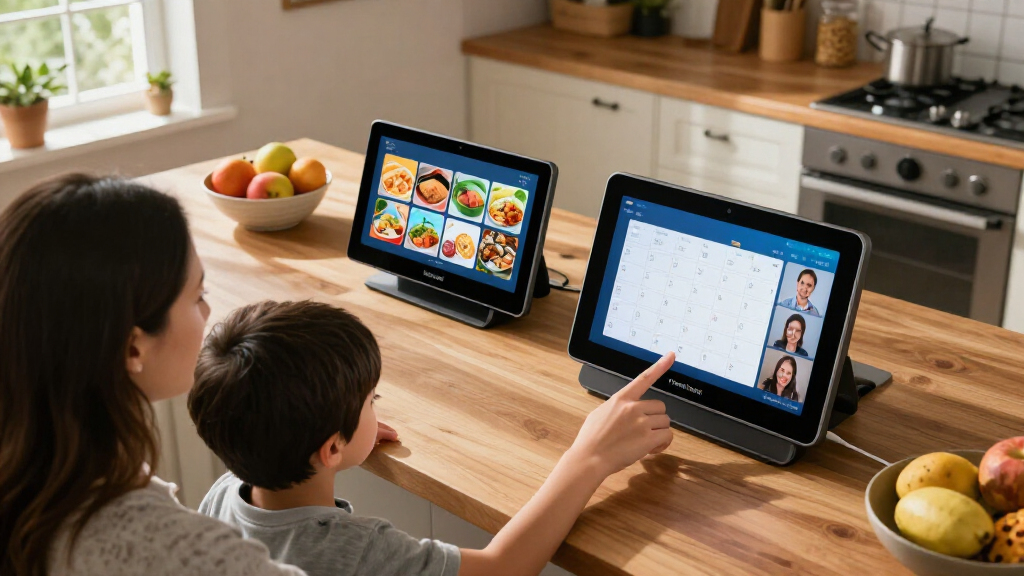
The report describes the intended role as a communal household screen, rather than a replacement for a laptop used for homework or paying bills. A wall or counter-mounted device could let family members check a calendar, view a grocery or meal plan, manage lights and other connected devices, or check a door camera without relying on one person’s phone. Amazon’s Echo Show 16 includes a family-management home screen with meal-planning features, while Apple’s device combines built-in apps with functions that rely on an iPhone.
The products take different approaches to who the smart display serves. Amazon presents the Echo Show 16 as a screen for the household that can be set up without a phone, though the report says a phone can help. Apple’s HomeView is more closely tied to the iPhone and its owner: some features depend on the phone being nearby and the device recognizing the person. The report’s examples of assistant and smart-home capabilities were demonstrations, not confirmation of performance across ordinary use.
The products are designed to bring household information and connected-home controls together, including schedules, meal plans and device controls. A fixed, shared screen could make those functions available to multiple household members without requiring them to borrow a phone or locate a tablet.
The new models cost more than earlier smart displays. The report compares them with 2023 devices, when the Echo Show 5 cost $85 and the Nest Hub cost $99. HomeView starts at $299, while the Echo Show 16 is listed at $499.99. The reviewer said further testing is needed to assess the devices’ usefulness and ease of use.
The products also differ in how they are designed to serve users. Apple’s approach appears to rely more on individual accounts and personal context, while Amazon presents its device as serving the household collectively. The distinction could affect the information each device can use and which features are available to people who do not own or carry a particular phone.
Products Worth Considering

Philips Hue Bridge Pro Smart Lighting Hub

Sony BRAVIA 5 85-Inch Mini LED 4K HDR Smart TV (K-85XR50)

Blueair Blue Pure 211i Max Smart Air Purifier
As an affiliate, we earn on qualifying purchases.
From Smart Speakers to Household Hubs
The launch follows years of criticism that smart displays combined a touchscreen with a speaker but did not perform either role especially well. The Verge reviewer said that, three years earlier, the category had become stuck with underpowered Google and Amazon devices that attempted many tasks without doing them well. The new products are presented as a response to that gap, with stronger components and clearer household uses.
The report also points to demand for dedicated family screens, citing the popularity of products such as the Skylight Calendar. Tablets offer some similar functions, but the reviewer says they can be difficult to share among users and may be moved around or left uncharged. The reviewer’s experience with Google’s Pixel Tablet, a tablet that could also serve as a smart display, included concerns about its detachable screen and smart-home support. The report says Google reportedly canceled its successor about 18 months later.
Apple and Amazon are also positioning these screens around their broader ecosystems. HomeView extends Apple’s iPhone-centered services, while the Echo Show 16 is designed to work as a household device and draw on Amazon’s smart-home products, including Ring cameras. That creates different trade-offs around personal information, setup and who can use the screen.
“These could finally turn the smart display into what it should have been all along: the family computer.”
— The Verge reviewer
How They Perform at Home
The report is based on brief hands-on time, so it does not establish whether either screen will prove reliable and convenient across everyday household routines. Battery life is not identified as a central issue for these products in the report, but details about setup, multiuser access and how consistently shared features work are not fully laid out.
It is also unclear how much of HomeView’s functionality will be available to people who do not own an iPhone, or how the device handles shared access when it cannot identify a particular person. Amazon’s demos included home sensing and Ring-camera features, but the report does not verify their performance in a range of homes or explain all setup requirements. The products’ prices are stated, but the supplied material does not detail regional availability, release dates by market or any additional costs.
Long-Term Testing Will Decide
Further household testing could assess whether family members use the shared calendar and controls, whether multiple people can access the features they need, and how consistently the assistants respond. Buyers will also need product and availability details from Apple and Amazon for their markets, including which functions require a phone, account or compatible smart-home device. The available assessment is based on brief hands-on use and does not establish whether either display addresses the reported limitations of earlier smart displays.
Key Questions
What are the Apple HomeView and Amazon Echo Show 16?
They are new smart displays intended to provide a shared household screen for tasks such as checking calendars and managing connected devices. The Verge report describes them as possible family hubs, not replacements for computers used for homework or bills.
How much do the two devices cost?
The report lists the HomeView at $299 and the Echo Show 16 at $499.99. It does not provide further details about regional pricing or availability.
How do Apple and Amazon’s approaches differ?
Apple’s HomeView is closely tied to the iPhone and some features appear to rely on a nearby phone and user recognition. Amazon’s Echo Show 16 is framed as a device for the household and can be set up without a phone, though a phone may help.
Have the devices been fully tested in homes?
No. The Verge reviewer reported brief hands-on time and said proper testing is still needed. The demonstrations and early impressions do not establish how reliably the devices will work during everyday household use.
Source: theverge.com