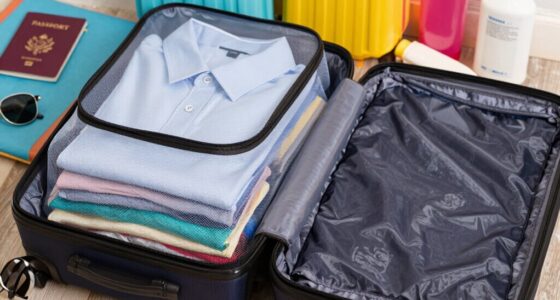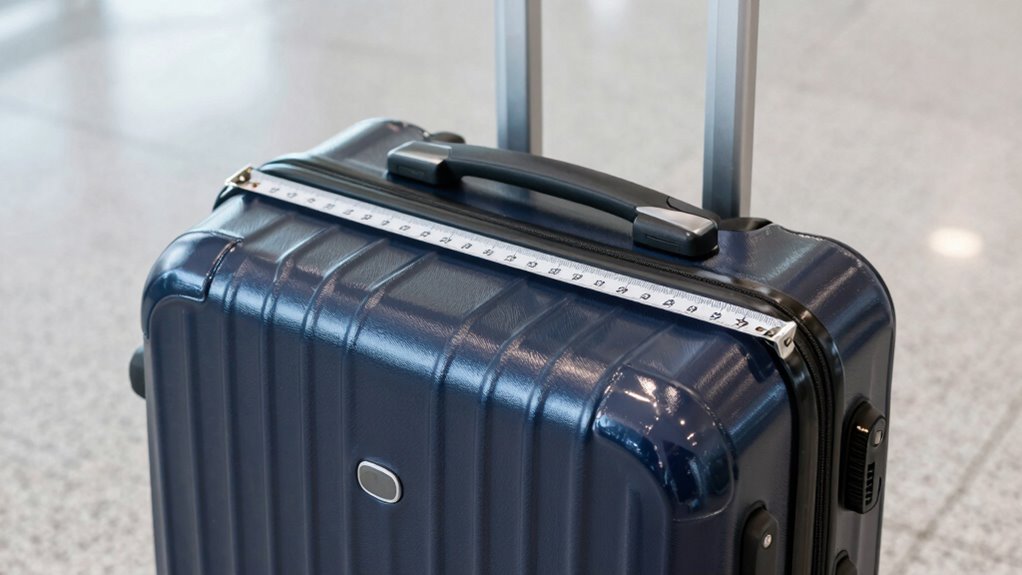

To measure your suitcase correctly for airline travel, use a flexible measuring tape or a ruler to find its length, width, and height on a flat surface, ensuring you measure from the outermost points including handles and wheels. Weigh your suitcase with a reliable scale before packing to confirm it stays within weight limits. Double-check all measurements and weight at the airport, and learn helpful tips to avoid common mistakes that could cause issues during check-in.
Key Takeaways
- Use a flexible measuring tape to measure the suitcase’s length, width, and height on a flat surface.
- Measure from outermost points, including handles and wheels, for airline compliance.
- Keep the tape straight and taut, avoiding slack for accurate dimensions.
- Record measurements in centimeters or inches, and re-measure after packing for confirmation.
- Check airline size restrictions beforehand and ensure your suitcase fits within those limits.

LIGHT FLIGHT Carry On Luggage 22x14x9 Airline Approved, Durable Hard Shell Carry On Suitcases with Wheels, Expandable Hardside Lightweight Travel Luggage with TSA Lock, Royal Blue
Airline-approved Luggage: This 20-inch carry-on Luggage meets the overhead compartment size requirements of most airlines. The durable hardside…
As an affiliate, we earn on qualifying purchases.
As an affiliate, we earn on qualifying purchases.
How to Measure Your Suitcase’s Dimensions Accurately
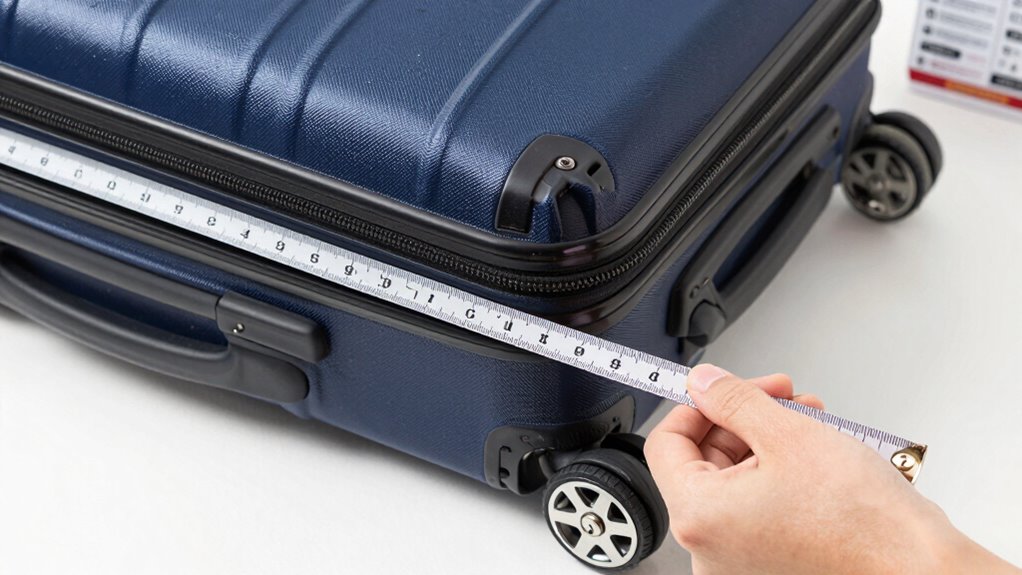
To measure your suitcase’s dimensions accurately, start by gathering a flexible measuring tape or a ruler that can handle the length, width, and height. This step is essential for effective travel packing and maintaining good luggage organization. Place your suitcase on a flat surface, and gently stretch the tape across the longest points to get the length, width, and height. Be sure to measure from edge to edge without bending the tape, as this ensures precision. Keep track of each measurement separately. Accurate dimensions help you avoid surprises at the airport and ensure your luggage fits airline size restrictions. Using these measurements, you can pack efficiently and stay organized, making your travel experience smoother and less stressful. Additionally, understanding how to measure your suitcase correctly can help you select the right size for various travel needs and prevent overpacking.
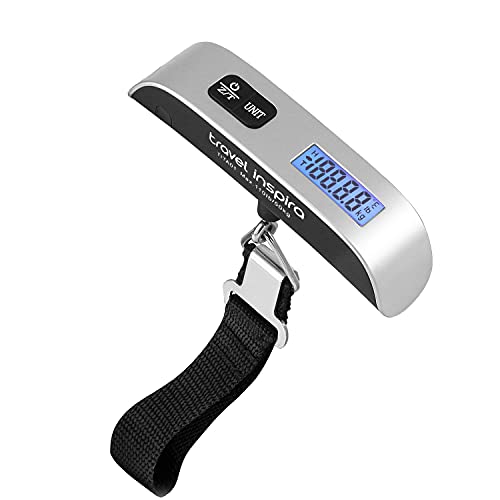
travel inspira Luggage Scale, Portable Digital Hanging Baggage Scale for Travel, Suitcase Weight Scale with Rubber Paint, 110 Pounds, Battery Included – Silver
[Travel without stress] This hanging baggage scale easily prevents overweight baggage charges; a must-have for traveling. *The isolation…
As an affiliate, we earn on qualifying purchases.
As an affiliate, we earn on qualifying purchases.
Knowing Airline Size and Weight Limits
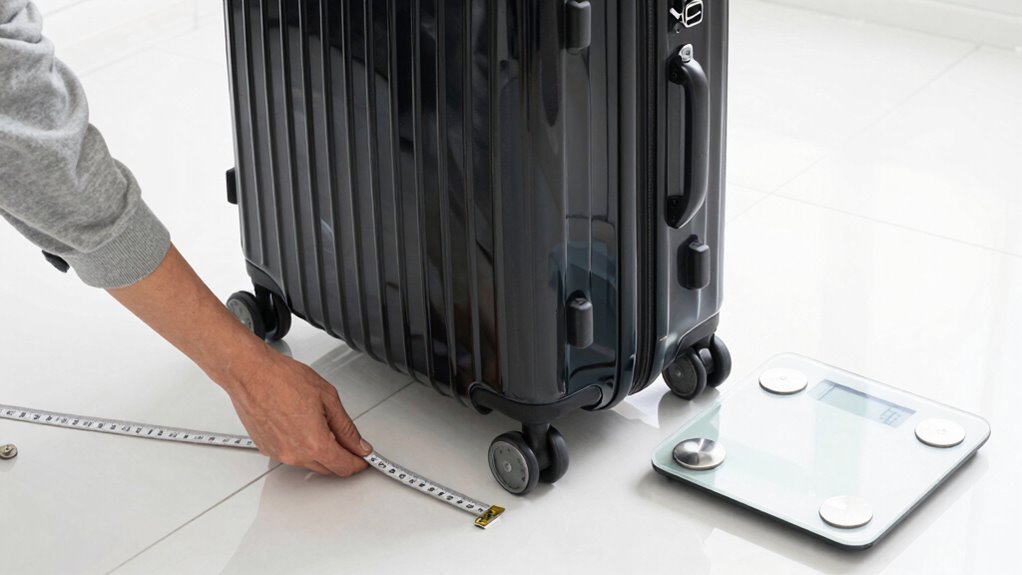
Understanding airline size and weight limits is essential before you pack your suitcase, as these restrictions vary by airline and fare class. Check the airline’s website for specific size dimensions and weight allowances for your ticket type. Pack travel accessories efficiently to maximize space and avoid excess weight. Use packing strategies like rolling clothes and placing smaller items inside shoes to save room. Remember, exceeding weight limits often results in extra fees, so weigh your suitcase before heading to the airport. Being familiar with these limits helps you choose the right suitcase size and plan your packing accordingly. Proper knowledge allows you to pack light, smart, and within the airline’s guidelines. Knowing airline restrictions** can also help you select the most suitable luggage, especially if you prefer hard-shell suitcases made from sturdy materials. Additionally, understanding sound vibrations and their effects on cellular health can inspire you to incorporate calming music or sound therapy into your travel routine for a more relaxed journey. Recognizing luggage weight regulations can help you avoid surprises at the check-in counter and streamline your travel experience. Incorporating backyard transformation essentials** such as outdoor seating or fire pits can also make your travel experience more enjoyable by creating a relaxing space at home after your trip.
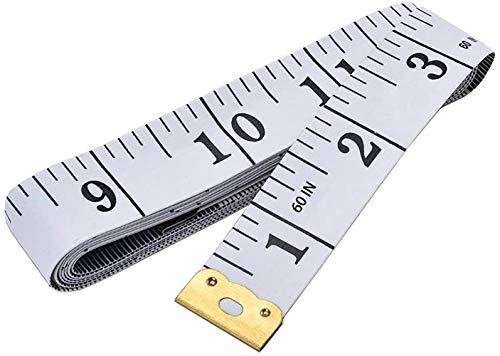
GDMINLO Soft Tape Measure Double Scale Body Sewing Flexible Tailor Craft Vinyl Ruler for Weight Loss Medical Body Measurement, Has Centimetre Scale on Reverse Side 60-inch(White)
Measuring range: 0 to 60 inches and 0 to 150 centimeters. There is a centimeter scale on the…
As an affiliate, we earn on qualifying purchases.
As an affiliate, we earn on qualifying purchases.
Choosing the Best Tools to Measure Your Suitcase
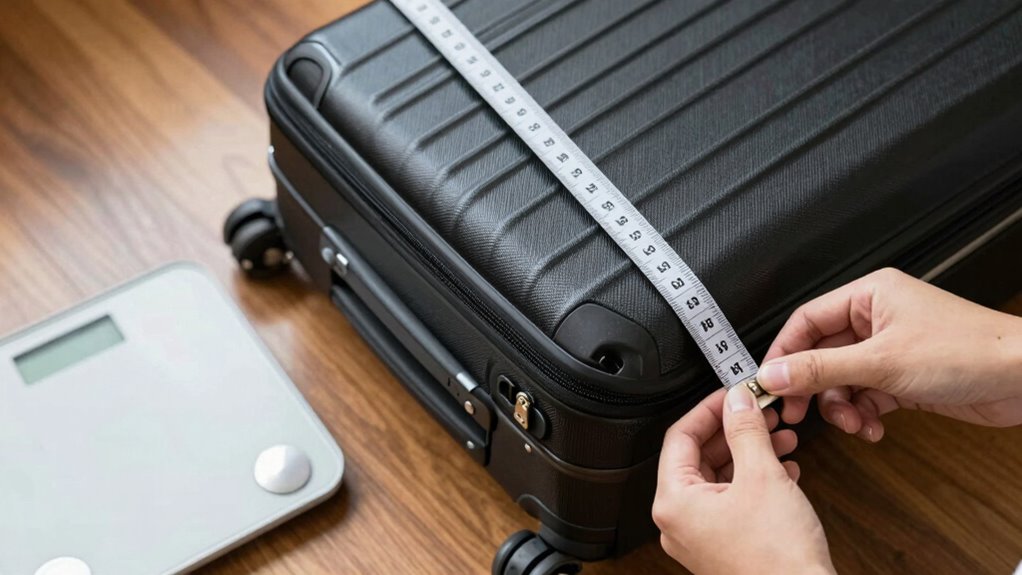
When selecting tools to measure your suitcase, you’ll want to think about both essential devices like tape measures or rulers and your preferred technology. Digital tools can offer quick and accurate readings, but manual devices are simple and reliable. Think about your travel needs and comfort with technology to choose the best option for you. Additionally, consider the size of the jewelry or accessories you’ll be packing to ensure they fit comfortably, which is similar to choosing the right body jewelry measurements for piercings. Ensuring your measuring tools are precise can also help you stay aligned with airline size restrictions, preventing any surprises at the airport. Paying attention to consistent feedback on your measurements can help you refine your technique and avoid errors. Incorporating digital literacy skills can enhance your ability to utilize high-tech measuring devices effectively. Being aware of the importance of measurement accuracy can further improve your packing and travel experience.
Essential Measuring Tools
Choosing the right measuring tools is essential to accurately determine your suitcase’s dimensions. The best travel accessories for this task are a sturdy measuring tape or a retractable ruler, both of which are compact and easy to use. These packing essentials help you get precise measurements without hassle. A flexible measuring tape is ideal for wrapping around irregular shapes or hard-to-reach corners, ensuring accuracy. Avoid using a ruler alone, as it might not fit around your suitcase’s curves. Keep a small, portable tape in your travel kit so you can quickly measure your luggage before heading to the airport. Using reliable tools guarantees you stay within airline limits and prevents surprises at check-in. Proper measuring tools make the process straightforward and help you avoid unnecessary fees. Additionally, understanding the dimensions of electric bikes can be useful if you plan to transport larger items like bike accessories or specialized luggage. Having knowledge of standard luggage sizes can also assist in choosing the right suitcase for your travel needs.
Digital vs. Manual Devices
Digital devices offer quick, accurate measurements with the push of a button, making them a popular choice for measuring your suitcase. Historically, manual tools like tape measures were standard, but digital technology has advanced markedly, offering enhanced precision and ease of use. When choosing between digital and manual devices, consider material durability—digital tools often feature sturdy, long-lasting components that withstand travel conditions. Manual devices are simple and don’t require batteries, but they can be less precise and more prone to human error. Digital tools provide instant readings, while manual ones demand careful handling. Your choice depends on your needs and preferences, balancing convenience with reliability. Additionally, understanding the regional diversity of urban and cultural attractions can help you select the most suitable measurement tools for different travel destinations.

LUGGEX Carry On Luggage 22x14x9 Airline Approved, KVC Expandable Polycarbonate Hard Shell Suitcase for Travelling (EX-Core, Charcoal Metallic, 20 Inch, 40L-44L)
Overall Dimensions: 21.5 x 13.8 x 9 IN (Including spinner wheels, handle, accessories, etc.), Weight: 7.5 LB, Capacity:…
As an affiliate, we earn on qualifying purchases.
As an affiliate, we earn on qualifying purchases.
How to Measure Suitcase Length, Width, and Height
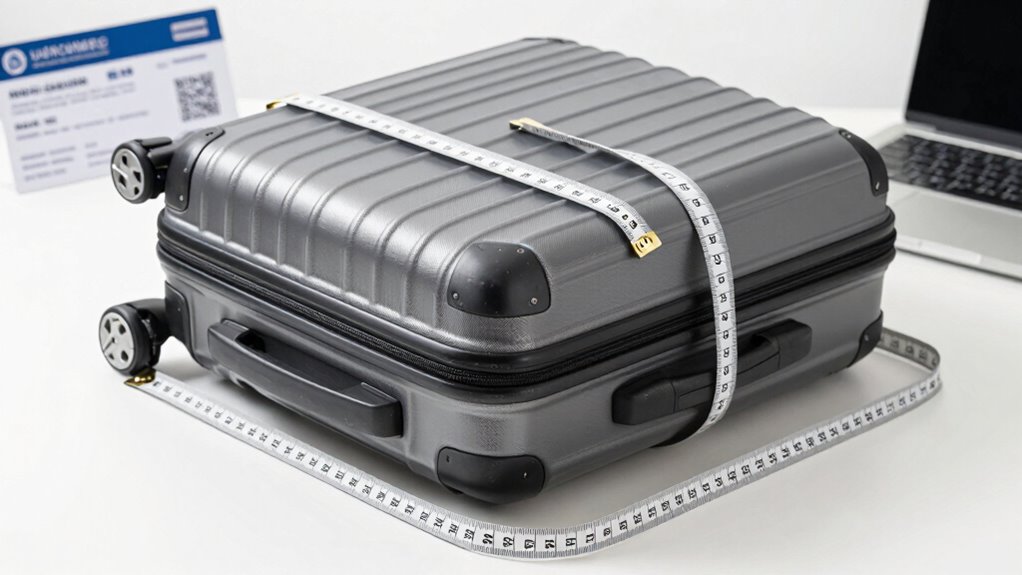
To accurately measure your suitcase’s dimensions, start by placing it on a flat, sturdy surface. First, measure the length by extending your tape measure from the front to the back of the suitcase, making certain it follows the longest part. Next, measure the width by placing the tape across the widest point from side to side. For the height, measure from the bottom to the top, including any wheels or protrusions. Don’t forget to check the suitcase interior if your airline requires it, as interior measurements can differ. To include the handle length, extend the handle fully and measure from the bottom of the suitcase to the top of the handle. Keeping these measurements accurate helps guarantee your luggage complies with airline size restrictions.
How to Weigh Your Suitcase Properly Before Travel

Before heading to the airport, it’s essential to weigh your suitcase to guarantee it meets airline weight restrictions. Properly weighing your bag promotes travel safety and packing efficiency, preventing surprises at check-in. Use a reliable luggage scale or a bathroom scale for accuracy.
Weigh your suitcase before traveling to ensure it meets airline weight limits and avoid check-in surprises.
- Place your suitcase on the scale, ensuring it’s fully packed and zipped.
- Record the weight displayed clearly.
- Weigh yourself first, then weigh yourself holding the suitcase, subtract to find the suitcase’s weight.
- Repeat if necessary to confirm accuracy.
- Always weigh your suitcase before leaving home to avoid last-minute adjustments.
- Incorporating accurate measurement techniques can further improve your packing routine and ensure you stay within weight limits.
- Understanding time zones can also help you plan your packing schedule more efficiently, especially when traveling across multiple regions.
- Being aware of airline policies can help you better prepare and avoid unexpected fees or restrictions.
- Familiarizing yourself with weight measurement standards can lead to more consistent and reliable results, reducing the chances of overpacking.
- Additionally, understanding privacy policies related to digital check-in and baggage tracking services can help you manage your travel data securely.
This simple step helps you stay within weight limits, reducing the risk of extra fees and ensuring your packing is efficient. It’s a quick, vital part of smart travel preparation.
Practical Tips to Keep Your Suitcase Within Airline Limits
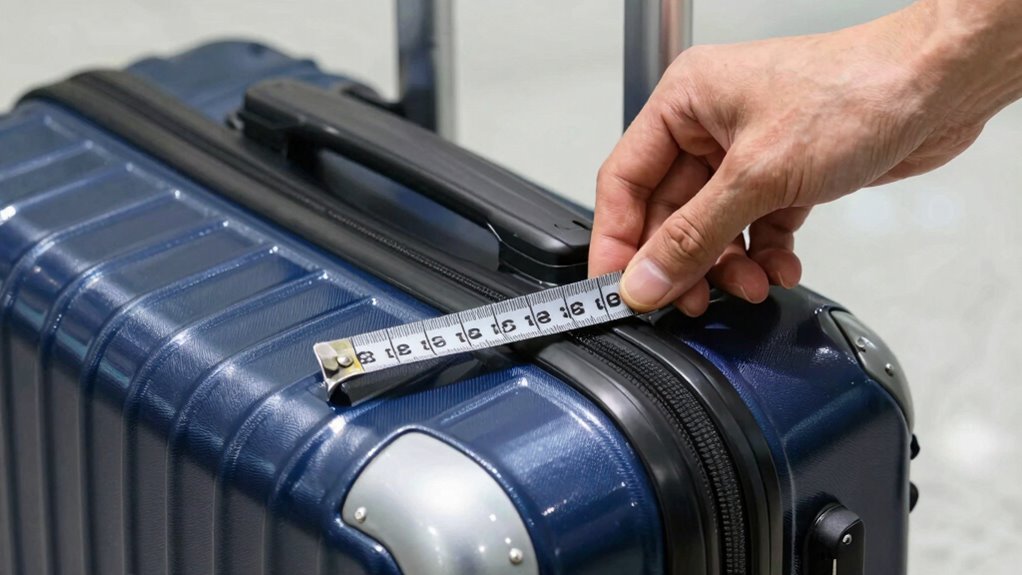
Staying within airline weight limits requires a combination of smart packing and careful planning. Focus on efficient travel packing by choosing versatile clothing and packing only essentials. Use suitcase organization techniques, like packing cubes or compartments, to maximize space and prevent overpacking. Keep heavier items at the bottom of your suitcase to distribute weight evenly. Weigh your suitcase regularly during packing to confirm you stay within limits, avoiding surprises at the airport. Consider packing lighter shoes or removing unnecessary items to reduce weight. Use a luggage scale for accuracy and double-check the airline’s weight restrictions before heading to the airport. Additionally, golf heritage and women’s LPGA achievements can inspire you to pack stylish yet functional clothing suitable for various occasions. Being aware of air quality benefits can also help you choose clothing and accessories that support your health during travel. Paying attention to weight distribution techniques can further help in maintaining balance and preventing damage to your luggage. Proper suitcase organization can make a significant difference in how much you can pack efficiently and comfortably. By organizing your suitcase effectively and being mindful of weight, you can travel with confidence and avoid extra fees or delays. Staying informed about tax law updates can also help you plan financially for frequent travel or business trips.
Common Mistakes When Measuring Suitcases and How to Avoid Them
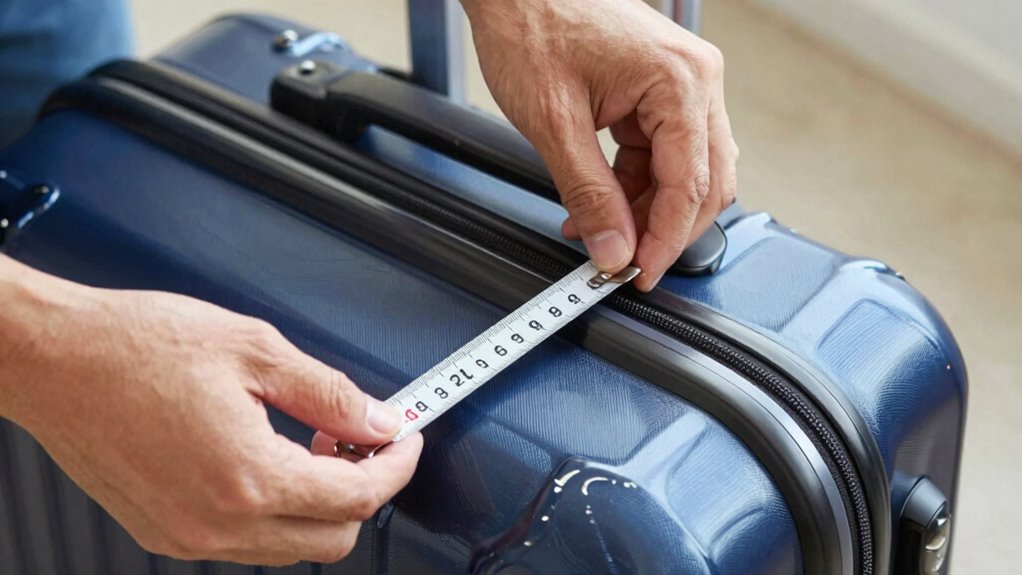
Many travelers make the mistake of using inconsistent measurement methods, which can lead to inaccurate size assessments. Ignoring airline size limits or measuring without padding can cause you to overestimate or underestimate your suitcase’s dimensions. To avoid these errors, use a consistent technique and include padding to get an accurate measurement that stays within airline restrictions. Additionally, understanding work-life harmony can help you plan more effectively for travel and reduce stress caused by last-minute surprises.
Inconsistent Measurement Techniques
Inconsistent measurement techniques often lead to discrepancies that can cause frustration and confusion when choosing the right suitcase. To avoid this, ensure you’re measuring correctly and consistently. Use a sturdy, flat surface and measure from the outermost points, not interior space. Keep your tape measure or ruler straight and taut, avoiding slack. Remember, including or excluding handles or wheels can impact your results. When packing travel accessories or planning packing strategies, double-check measurements to prevent surprises at the airport.
- Always measure with the suitcase fully packed or empty, depending on airline rules
- Measure with the suitcase standing upright for accuracy
- Use a flexible tape for irregular shapes
- Record measurements in centimeters or inches, consistently
- Compare measurements across different sources for clarity
Ignoring Airline Size Limits
Have you ever measured your suitcase only to find it slightly over the airline’s size limit? Ignoring airline size limits can lead to unexpected fees or having to check your luggage last minute. When checking measurements, don’t rely solely on luggage branding, which can be misleading, or assume your suitcase’s maximum dimensions are accurate. Remember, material durability varies, and some soft-sided bags may stretch or compress, altering their size. Always measure with a tape measure at the largest points, including wheels and handles, and double-check airline restrictions. Overlooking these details risks your luggage exceeding size limits, despite appearances. Being precise and mindful ensures your suitcase stays within the allowed dimensions, saving you time, money, and frustration at the airport.
Measuring Without Padding
Measuring your suitcase without padding might seem straightforward, but it’s a common mistake that can lead to inaccurate results. Ignoring padding considerations and suitcase material can cause you to underestimate its true size. To get precise measurements, always take into account any padding or interior lining that adds bulk. Remember, soft-sided suitcases expand slightly when filled, so measure at their fullest point.
- Avoid measuring just the external shell, including padding that adds to size
- Don’t forget the suitcase’s material, as flexible fabrics can stretch or compress
- Use a flexible tape measure for curves and corners
- Measure at the widest point, including handles or wheels if they protrude
- Check the manufacturer’s guidelines for measuring soft-sided cases
Being mindful of padding considerations and suitcase material ensures your measurements are airline‑friendly.
Final Checks to Confirm Your Suitcase Fits Airline Limits
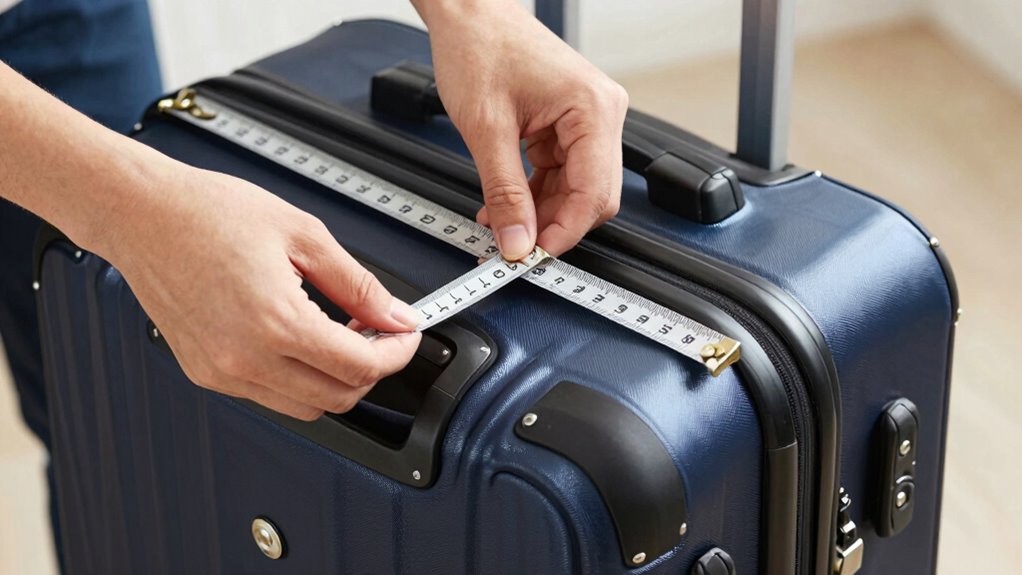
Before heading to the airport, it’s essential to double-check that your suitcase meets the airline’s size and weight restrictions. Carefully remeasure your luggage, making sure it remains within the limits after packing. Confirm that your travel packing is efficient, with everything organized to avoid overpacking, which can cause weight issues. Use a tape measure to verify the suitcase’s dimensions, and weigh it on a reliable scale. Tackle luggage organization by removing unnecessary items if your suitcase is close to the limit. This final check helps prevent surprises at the check-in counter, saves time, and reduces stress. Remember, a well-packed, properly measured suitcase ensures smooth travel and adherence to airline policies. Taking these steps guarantees your luggage is airline-friendly and ready for your trip.
What to Do If Your Suitcase Is Slightly Over the Limit?
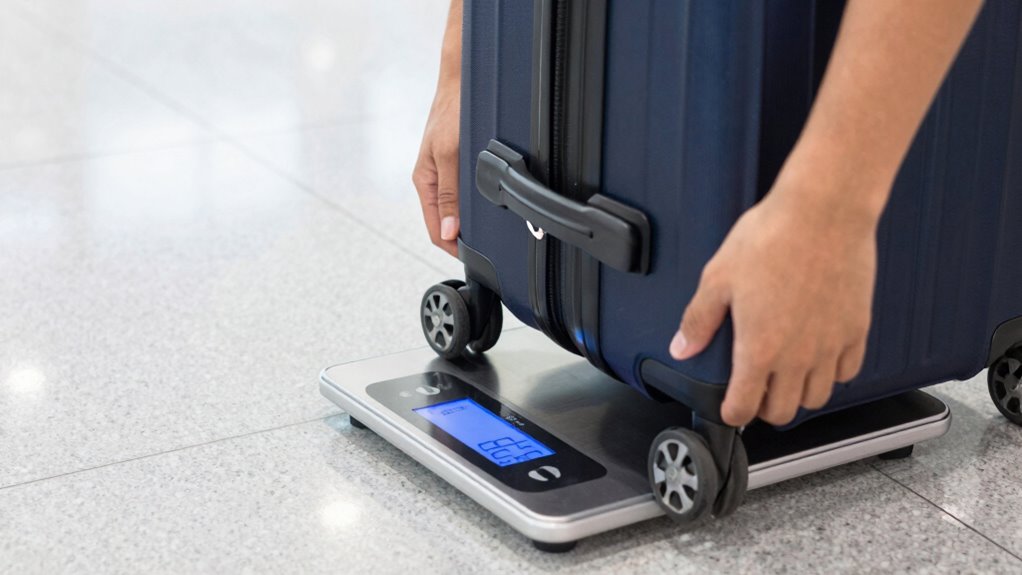
If your suitcase is just over the limit, try redistributing items to balance the weight better. You can also remove non-essential items or use portable weighing devices to double-check the weight. These simple steps can help you stay within limits without hassle.
Redistribute Items Strategically
When your suitcase exceeds the weight limit by just a small amount, the key is to redistribute items efficiently. Start by reorganizing your clothing, using packing cubes or clothing compression techniques to save space and weight. Shift heavier items like shoes or toiletries into your carry-on or another bag if possible. Consider consolidating lighter clothing from different compartments to balance the weight.
- Use packing cubes to compartmentalize and compress bulky items
- Move extra shoes or heavier accessories to your carry-on
- Distribute toiletries evenly between bags
- Flatten bulky clothing with clothing compression
- Reassess the placement of items to evenly spread weight
This strategic redistribution helps avoid extra fees and keeps your suitcase within airline limits while maximizing space.
Remove Non-Essential Items
After reorganizing and redistributing your items, you might still find your suitcase slightly over the weight limit. In this case, it’s time to eliminate non-essential items. Use packing tips that focus on practicality—leave behind travel essentials you can do without for a few days. Consider whether you truly need multiple pairs of shoes or bulky clothing. Prioritize versatile clothing pieces that serve multiple purposes. Remember, lightweight alternatives for toiletries and accessories can save significant weight. Be honest with yourself about what’s essential and what can be left behind. Removing non-essentials not only helps meet airline restrictions but also makes your suitcase easier to handle. Staying mindful of your packing tips ensures you travel light without sacrificing what’s important.
Use Portable Weighing Devices
A portable weighing device is a handy tool to quickly determine your suitcase’s weight and avoid surprises at the airport. If your bag’s just a little over the limit, using one can save you stress and last-minute repacking. It’s a simple packing hack that keeps you in control, especially when balancing fashion trends with travel requirements.
Here are some tips:
- Weigh your suitcase before leaving home to prevent overpacking.
- Use the device to test heavy items, like shoes or gadgets.
- Shift bulky items to carry-on if possible.
- Reorganize your packing to distribute weight evenly.
- Remember, lightweight travel essentials help stay within limits.
A portable scale helps you stay stylish and compliant, making your travel experience smoother.
Double-Check Your Measurements and Weight Before Heading to the Airport
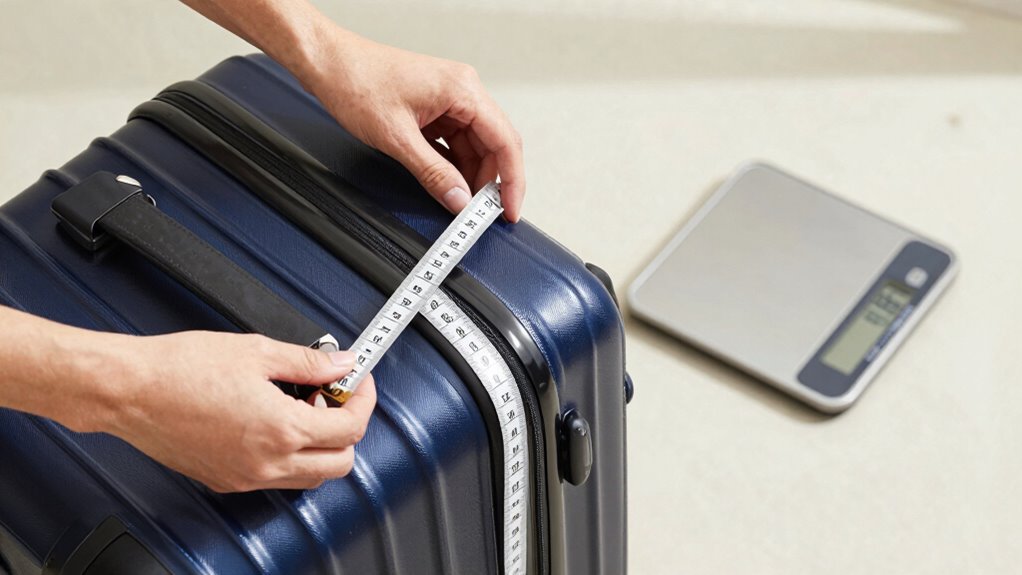
Before heading to the airport, double-check your suitcase’s measurements and weight to avoid surprises at check-in. Accurate measurements verify your luggage meets airline size restrictions, preventing delays or extra fees. Weigh your suitcase again with your portable device to confirm it stays within weight limits, supporting travel safety by preventing overpacking or damage. Double-checking helps you spot any miscalculations in your packing efficiency, so you can remove unnecessary items if needed. Being precise with your suitcase’s dimensions and weight streamlines the check-in process and reduces stress. It also minimizes the risk of having to rearrange or repack at the airport, saving time. Ultimately, this extra step guarantees smoother travel and peace of mind, knowing your luggage complies with airline policies.
Frequently Asked Questions
How Do Different Airlines Vary in Their Suitcase Size Regulations?
Different airlines vary in their luggage dimensions and policies, so you should always check each airline’s specific guidelines before packing. Some airlines allow larger carry-on sizes, while others have stricter limits. Airline policies can also differ on weight restrictions. To avoid extra fees or hassle, measure your suitcase accurately and compare it to the airline’s luggage dimensions. Always review these details in advance to guarantee your luggage complies with each airline’s regulations.
Can I Measure My Suitcase After Packing to Ensure It Still Fits?
Yes, you can measure your suitcase after packing to guarantee it still fits. Use packing tips like compressing clothes and organizing efficiently to maximize space. Once packed, carefully measure the suitcase’s length, width, and height with a measuring tape, keeping in mind airline size restrictions. This helps you avoid surprises at the airport and ensures your suitcase remains airline-friendly, even after packing.
What Are the Best Portable Tools for Measuring Travel Luggage?
Did you know that over 60% of travelers struggle with luggage weight and size limits? For travel packing, the best portable tools are compact digital scales and flexible tape measures. Digital scales quickly weigh your luggage to avoid extra fees, while tape measures help check dimensions on the go. Both are lightweight, easy to carry, and guarantee your luggage stays within airline restrictions, making packing stress-free.
How Often Should I Re-Measure My Suitcase Before Each Trip?
You should re-measure your suitcase before each trip to make certain it meets airline size and weight restrictions, especially during travel packing. This helps avoid extra fees or having to leave items behind. Regularly checking your luggage weight and dimensions keeps you prepared for different airline policies. Use a portable measuring tool for quick, accurate results, guaranteeing your suitcase stays within limits and your travel packing stays smooth and stress-free.
Are There Specific Suitcases Designed to Meet Airline Size Restrictions?
Yes, there are suitcases specifically designed to meet airline size restrictions. Look for travel accessories that feature lightweight, durable luggage materials like polycarbonate or ABS, which help keep your bag within size limits without adding extra weight. Many brands offer carry-on sizes with built-in measurements or expandable compartments, making it easier to stay compliant with airline policies. Choose these options to guarantee hassle-free travel and avoid extra fees.
Conclusion
Think of packing like preparing a ship for voyage—you want to stay within the safe harbor of airline limits. Double-check your measurements and weight as if you’re charting your course, ensuring a smooth journey. With your suitcase correctly sized and weighed, you’re ready to set sail without worries. So, measure twice, weigh once, and enjoy your travels knowing you’re well-prepared for the adventure ahead. Bon voyage!