TL;DR

Get home appliances delivered free with Prime
- Fast, free delivery on millions of items
- Prime Video, Amazon Music and more included
- Member-only deals all year
A House Beautiful report describes designers turning more often to quartzite, granite, soapstone and porcelain slabs as alternatives to engineered quartz. The shift is a design trend, not evidence that quartz countertops are being phased out nationwide; the report also cites a California production ban as reportedly in preparation, without details on its status or scope.
Designers interviewed by House Beautiful say they are steering some homeowners away from engineered quartz countertops and toward natural stone or porcelain, citing aesthetics, performance expectations and concerns about fabrication workers’ exposure to crystalline silica. The report describes a shift in design preferences, not a confirmed nationwide phaseout of quartz.
The report points to a National Kitchen & Bath Association annual trend report, saying 78 percent of designers are sourcing quartzite while fewer are selecting quartz. That figure concerns sourcing activity, not the share of kitchens with quartz counters or a measured decline in sales. The article does not give the survey’s sample size, field dates or a comparison figure for earlier years.
Designers cited in the report say homeowners often choose quartz for its reputation for durability and low maintenance, but may expect more than the surface can deliver. Jessica Risko Smith said clients sometimes treat it as a “worry-free, bulletproof surface,” while Steven Cooper cautioned that quartz is stain-resistant, not stain-proof. These are designers’ observations, not a product-wide performance study.
For alternatives, the designers named quartzite, marble, granite and soapstone, as well as porcelain slabs. Natural stone can develop marks and patina and may need more maintenance, according to the report. Camp and Cooper recommended porcelain for some clients, describing it as durable and offering a lower-cost option in certain projects; the article does not provide comparative prices or independent durability testing.
Choices Beyond Engineered Quartz
Countertops are a costly, disruptive part of a kitchen renovation, so changing preferences can affect homeowners weighing appearance, upkeep and price before committing to a material. The report suggests that some clients are placing greater value on natural variation and patina than on a surface designed to look consistent over time.
There is also a worker-safety dimension separate from the design trend. The article links concern about engineered-stone fabrication to crystalline silica exposure, which can cause silicosis. That concern relates to workers who cut and process the material; the source does not establish a comparable risk from simply having an installed countertop in a home.
Products Worth Considering

TCL 85-Inch QM6K Series QLED Mini LED 4K HDR Smart Google TV

Bose TV Speaker Compact Soundbar with Bluetooth and HDMI-ARC, Black

Samsung 85 M80H Series Mini LED 4K Smart TV (2026)
As an affiliate, we earn on qualifying purchases.
Why Designers Are Reconsidering Quartz
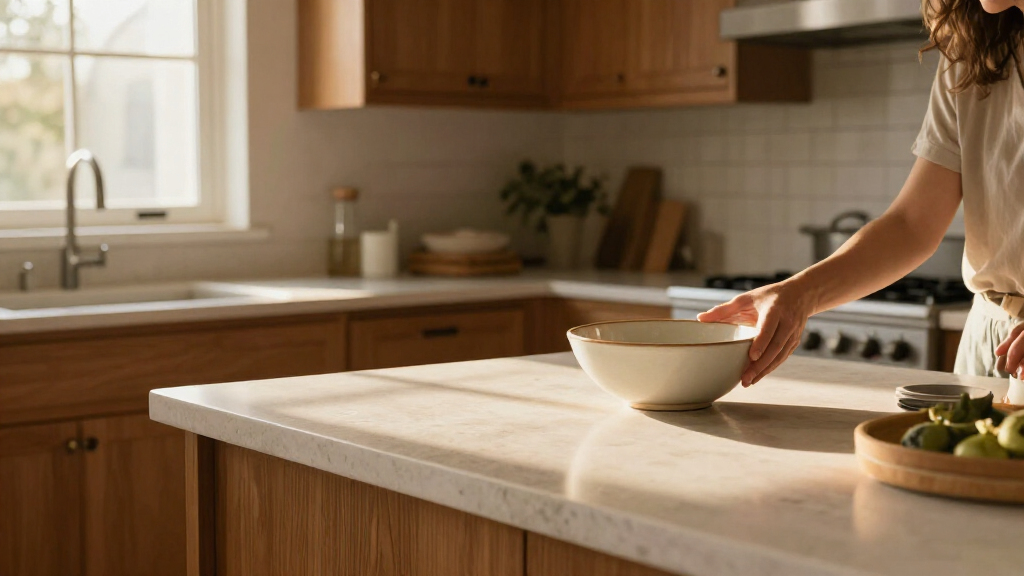
Engineered quartz became popular partly because it can imitate the veining of marble while offering consistent patterns and relatively low maintenance, according to House Beautiful. The designers quoted say those advantages have not always matched clients’ expectations: quartz can show wear or stains, and it does not provide the same natural variation as quarried stone.
The report also says California is reportedly preparing to ban production of engineered quartz because of silica-related health concerns. It characterizes the measure as a production ban, but provides no bill or agency details, effective date, or confirmation that it has taken effect. A designer’s prediction that other regions could follow is an expectation, not an announced policy elsewhere.
““We’ve always felt that quartz lacks the depth, warmth, and individuality of natural stone.””
— Barrett Oswald, interior designer
Ban Status and Trend Data
The report does not establish whether California has formally proposed, enacted or scheduled a production ban, or precisely which products and activities any measure would cover. It also offers no timeline or confirmation of similar rules in other states. The East Coast precautions mentioned by designer Kilian Camp are a forecast, not a government announcement.
The 78 percent sourcing figure is presented without survey methodology, a prior-year comparison or a definition of “sourcing.” It cannot by itself show how quickly quartz is losing market share. Nor does the article provide sales data proving that quartz is being replaced across the countertop market. For homeowners, costs, maintenance needs and product performance will vary by material and installation.
What Homeowners Should Check
Anyone planning a renovation should compare samples and care requirements for the specific products under consideration, and ask fabricators about installation, sealing, repair and maintenance. A natural stone’s appearance and upkeep can vary, while porcelain and engineered surfaces also differ by product. The designers’ recommendations in the report are professional opinions, not a universal ranking.
On policy, the next concrete development would be an official California proposal or agency announcement clarifying whether a restriction is moving forward and when it could apply. Until then, the reported ban and possible spread of similar precautions remain unconfirmed or prospective.
Key Questions
Are quartz countertops being banned nationwide?
No nationwide ban is confirmed in the source report. It says California is reportedly preparing a production ban, but supplies no official status, scope or effective date.
What materials are designers recommending instead?
The designers cited recommend quartzite, marble, granite, soapstone and porcelain slabs. The right choice depends on budget, appearance and willingness to maintain the surface.
Is quartz completely stain-proof?
No. Cooper told House Beautiful that quartz is stain-resistant, not stain-proof. The report also quotes designers who say some clients expect more from its performance than it provides.
Does the silica concern mean an installed countertop is unsafe?
The report discusses crystalline silica exposure during fabrication and the risk of silicosis for workers. It does not establish that simply living with an installed countertop poses the same risk.
Source: housebeautiful.com