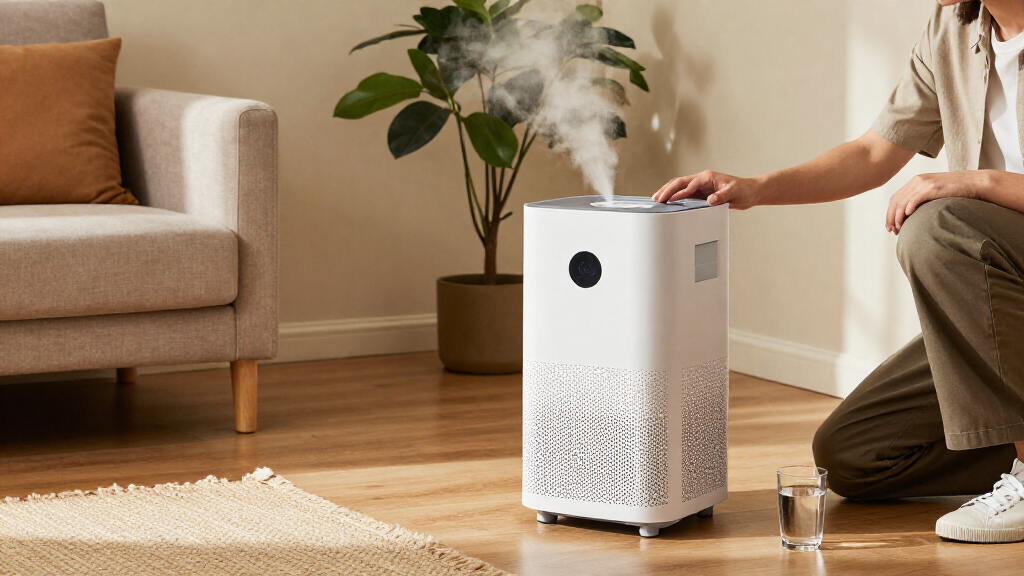

Use this guide to choose and run a portable humidifier that treats one room, such as a bedroom, nursery, or living room. It is for beginners who want to relieve dry indoor air while keeping humidity within a safe range. Plan about 30-60 minutes for measuring, setup, and the first adjustment, plus 10-15 minutes each week for cleaning and checks.

Get home appliances delivered free with Prime
- Fast, free delivery on millions of items
- Prime Video, Amazon Music and more included
- Member-only deals all year

DREO 11L Smart Humidifier Large Room 700 ft², 100H Runtime, 21dB Quiet 747S
- ✔ Capacity: 11 liters
- ✔ Stated coverage: Up to 700 sq. ft.
- ✔ Maximum runtime: Up to 100 hours

Levoit OasisMist 1000S (10L) Smart Humidifier for Home Large Room Bedroom
- ✔ Capacity: 10 liters
- ✔ Stated coverage: Up to 600 sq. ft.
- ✔ Maximum runtime: Up to 100 hours

Lacidoll 8L Large Humidifier for Bedroom Large Room Home 800 sq ft, Black
- ✔ Capacity: 2.1 gallons (about 8 liters)
- ✔ Stated coverage: Up to 800 sq. ft.
- ✔ Mist output: 300 mL/h
Difficulty: Beginner | Time: 30-60 minutes for setup; 10-15 minutes weekly for routine care
What You’ll Need
Tools & Materials:
- Whole room humidifier sized for the room
- Hygrometer, unless the humidifier has a reliable built-in humidity reading
- Clean water, following the manufacturer’s water recommendations
- Stable, water-resistant surface
- Mild soap and cleaning supplies specified in the manual
Knowledge:
- How to measure the room’s approximate length and width
- How to read the humidifier’s operating and cleaning instructions
Check the room size rating and the humidifier’s care instructions before buying or filling it. A portable whole room humidifier is different from a central humidifier attached to a heating and cooling system. Do not use additives, essential oils, or disinfectants in the tank unless the manufacturer specifically allows them.
DREO 11L Smart Humidifier Large Room 700 ft², 100H Runtime, 21dB Quiet 747S
The DREO 747S leads this roundup because it combines the largest tank here with a broad set of controls. Its 11-liter capacity and claimed runtime of up to 100 hours are especially relevant in a large room where stopping to refill every day would be inconvenient. DREO states coverage up to 700 square feet and describes a mist plume reaching six feet, a design intended to distribute moisture more broadly than a unit aimed close to the floor. Those figures make it an appealing fit for an open living area, though the stated coverage should still be weighed against room shape and airflow.Its app, voice, remote, and touch controls give it more ways to fit into a household routine than the Lacidoll, which relies on a remote and panel. The DREO also claims 21 dB operation and includes a sleep mode that dims the lights. That combination makes it the strongest bedroom-and-living-room crossover in this group. The Levoit offers a comparable 100-hour maximum runtime and a specified 350 mL/h mist output, while DREO’s supplied details emphasize tank capacity, automation, and quiet operation instead.There are tradeoffs. At nearly 32 inches tall, this is a substantial appliance, and its lighting and connected controls may be unnecessary for buyers who want a basic humidifier. The product information lists an anti-scale filter, so we would check its care requirements before choosing it over the Levoit or Lacidoll. Its maximum runtime also depends on operating conditions and settings, so we would not assume 100 hours at the highest output. For buyers who want fewer refills and flexible controls, however, DREO offers the most complete package here.
Pros:
- 11-liter capacity and stated runtime up to 100 hours
- Coverage claim up to 700 square feet with a six-foot mist plume
- App, voice, remote, and touch controls
- Sleep mode and stated 21 dB operation
Cons:
- Tall footprint may be awkward in a small room
- Anti-scale filter adds a care detail to consider
- Maximum runtime is not a guarantee at every output setting
Best for: Households humidifying a large bedroom or living area that want app or voice control and a large tank.
Not ideal for: Buyers seeking a compact, low-feature unit or who prefer to avoid filter-related upkeep and connected controls.
Bottom line: Choose the DREO 747S when a large tank, quiet sleep mode, and connected controls matter more than keeping the appliance simple.
“Choose the DREO 747S when a large tank, quiet sleep mode, and connected controls matter more than keeping the appliance simple.”
Levoit OasisMist 1000S (10L) Smart Humidifier for Home Large Room Bedroom
The Levoit OasisMist 1000S is the balanced pick for buyers who want substantial capacity without choosing the largest unit in the lineup. It holds 10 liters, claims up to 100 hours of operation, and is specified for rooms up to 600 square feet. Its listed mist volume of 350 mL/h gives us a concrete output figure to compare: that is higher than the Lacidoll’s stated 300 mL/h, even though Lacidoll advertises a larger coverage area. For buyers comparing room coverage claims, that difference is a useful reason to look beyond the headline square-foot figure.Levoit’s wide top-fill opening is a practical advantage. It is designed to make adding water and reaching inside for cleaning easier, which matters with a tank large enough that lifting and handling can become part of the daily routine. The VeSync app supports schedules and humidity customization, while Auto, Plant, Aroma, and Sleep modes give the unit a clear range of uses. Compared with DREO, Levoit specifies higher mist output and offers a slightly shorter, narrower tower; DREO counters with a larger tank, a higher stated coverage area, and more control methods.This model is a good fit for buyers who want app scheduling and a strong stated output without moving up to the DREO’s larger capacity. The compromise is that its coverage claim is the smallest of these three, at 600 square feet, so it is a less obvious choice for a very broad open-plan area. Its feature-rich modes may also be more than a buyer needs. The product description recommends distilled or purified water, a consideration for owners who want to minimize mineral residue. Overall, easy top filling and a specified 350 mL/h output make it a persuasive middle choice between DREO’s capacity-first approach and Lacidoll’s simpler controls.
Pros:
- 10-liter capacity with stated runtime up to 100 hours
- 350 mL/h mist output and coverage claim up to 600 square feet
- Wide top-fill opening intended to ease refilling and cleaning
- App scheduling and dedicated Plant and Sleep modes
Cons:
- Lowest stated coverage claim among these three models
- The recommendation to use distilled or purified water may add upkeep
- Smart modes and scheduling can be unnecessary for buyers wanting basic controls
Best for: People who want a large-room humidifier with app scheduling, a wide refill opening, and a stated 350 mL/h output.
Not ideal for: Buyers whose main priority is the highest stated coverage in this group or who do not want app features and mode options.
Bottom line: Pick the Levoit OasisMist 1000S for an easy-to-fill, app-controlled humidifier with a clearly stated output for a sizable room.
“Pick the Levoit OasisMist 1000S for an easy-to-fill, app-controlled humidifier with a clearly stated output for a sizable room.”
Lacidoll 8L Large Humidifier for Bedroom Large Room Home 800 sq ft, Black
The Lacidoll 8L is the straightforward option for buyers who want adjustable humidity and a remote without relying on an app. Its controls include three mist speeds, a timer, a digital display, and a humidity setting from 45% to 95%. That gives it more adjustment than a basic on-off humidifier, while keeping the interaction familiar. The leak-resistant top-fill design and detachable tank are intended to make refilling and cleaning less cumbersome than handling a closed tank.Lacidoll claims coverage up to 800 square feet, the largest figure in this group, but its listed mist output is 300 mL/h. That is lower than Levoit’s 350 mL/h, so buyers should not assume the biggest coverage claim means it will be the best match for every large or open-plan room. The 2.1-gallon tank is also smaller than the 10-liter Levoit and 11-liter DREO tanks. Its description says up to 48 hours, while the supplied product information lists a 24-hour runtime; we would treat runtime as uncertain and avoid making this the first choice for anyone prioritizing long intervals between refills.Where Lacidoll distinguishes itself is in the combination of an easy-to-understand panel and remote, low-water shutoff, sleep mode, and an aroma tray. Those features may suit a bedroom or home office where a phone app is not needed. Its filter-free design avoids filter replacement, but it still requires regular cleaning, as ultrasonic units do. Compared with the Levoit, it gives up stated mist output and app scheduling; compared with DREO, it has a smaller tank and fewer connected controls. In return, it offers a simpler approach and a higher advertised coverage figure. We would choose it for moderate, routine use when straightforward operation matters more than maximum capacity.
Pros:
- Remote and panel controls with adjustable humidity and three mist speeds
- Top-fill design and detachable tank for access during refilling and cleaning
- Low-water shutoff, timer, sleep mode, and aroma tray
- Filter-free design avoids scheduled filter replacement
Cons:
- Smaller tank than the DREO and Levoit models
- Stated output is lower than Levoit’s listed 350 mL/h
- Supplied runtime information conflicts between up to 48 hours and 24 hours
Best for: Buyers who want a remote-controlled bedroom or home-office humidifier with adjustable humidity and no app setup.
Not ideal for: People who need a dependable long runtime between refills or who are selecting primarily on demonstrated output for a large open-plan room.
Bottom line: Choose the Lacidoll when you want accessible remote controls and adjustable humidity, and can accept a smaller tank and less certain runtime.
“Choose the Lacidoll when you want accessible remote controls and adjustable humidity, and can accept a smaller tank and less certain runtime.”
As an Amazon Associate we earn from qualifying purchases.
Before You Start
Measure room humidity with a hygrometer if you can. Many homes do well around 30-50% relative humidity; keep humidity below 60% to limit conditions that encourage mold and dust mites. Cold windows and poorly insulated walls may develop condensation at lower readings, so use visible dampness as a reason to turn the unit down. Follow any advice from a clinician for a medical condition, and keep the device out of children’s reach.
Read the manual for clearance, water type, filter replacement, and cleaning guidance. Unplug the unit before filling, emptying, or cleaning it. Place it away from curtains, electronics, bedding, walls, and anything that could become wet.
Step-by-Step Instructions
Step 1: Measure the room
Measure the room’s length and width, then multiply them to estimate its floor area. Compare that figure with the coverage rating on the humidifier’s label. If the room has a high ceiling or an open layout, choose a model rated for a larger area or ask the manufacturer how it accounts for ceiling height.
Tip: A unit rated for a small bedroom may not humidify an open living area effectively.
Check: The model’s stated coverage includes the room you plan to humidify.
Step 2: Choose a suitable humidifier
Pick a model with a humidity control or humidistat, a tank size that suits how long you plan to run it, and parts you can clean easily. Check whether it uses a wick or filter and how often that part must be replaced. Evaporative models tend to leave fewer mineral particles in the air; ultrasonic models can disperse minerals from hard water as white dust.
Tip: If you choose an ultrasonic model, distilled or demineralized water can reduce mineral dust when the manufacturer permits it.
Check: You know the model’s room rating, water requirements, filter needs, and cleaning schedule.
Step 3: Select a safe location
Set the humidifier on a level, stable, water-resistant surface with the clearances specified in its manual. Aim the mist or outlet into open space, away from walls, curtains, furniture, electronics, and the bed. Keep the power cord out of walkways and place the unit where children and pets cannot pull it over.
Tip: Do not place the unit directly on wood or another surface that could be damaged by spills or condensation. Avoid raising it onto an unstable shelf.
Check: The humidifier stands securely, has open airflow around it, and cannot spray or drip onto nearby items.
Step 4: Rinse and fill the tank
Unplug the humidifier and remove the tank according to the manual. Rinse it if the instructions call for that, then fill it with the recommended water without exceeding the marked limit. Refit the cap and tank securely, and wipe up any spills before reconnecting power.
Tip: Do not add fragrance, oils, or medication to the water unless the manual names them as approved. Some additives can damage the device or disperse unwanted substances.
Check: The tank is seated correctly, has no leaks, and the surrounding surface is dry.
Step 5: Set a moderate humidity target
Plug the unit directly into a suitable outlet and turn it on using the manual’s directions. Set the target within a moderate range, typically about 40-50%, and use a lower setting if windows or walls become damp. If the unit lacks a humidistat, check a separate hygrometer regularly instead of running the humidifier continuously.
Tip: Do not aim for the highest setting. More moisture is not better if the room becomes clammy or condensation appears.
Check: The display or hygrometer shows a reading in your chosen range, and no nearby surface is getting wet.
Step 6: Adjust operation to the room
Let the humidifier run, then check the room’s humidity and nearby windows, walls, and furniture. Adjust the output or target gradually. If humidity stays low, verify that the unit is sized for the room, the tank is supplying water, and the filter or wick is installed and usable. Turn the device off when the target is reached or the room feels damp.
Tip: Readings can differ by location. Keep the hygrometer away from the mist stream, exterior doors, windows, and heat sources.
Check: Humidity stays in a comfortable range without visible condensation, wet surfaces, or persistent musty odor.
Step 7: Clean and store it regularly
Follow the manufacturer’s schedule for emptying, drying, and cleaning the tank and base. Unplug the unit first, use only approved cleaners, rinse as directed, and let parts dry before reassembling. Replace filters or wicks at the stated interval. When storing the humidifier, empty and dry it fully.
Tip: Standing water can support microbial growth. Do not leave unused water sitting in the tank between operating periods.
Check: The tank and base are free of visible scale or residue, parts are dry after cleaning, and the filter is within its service life.
Common Mistakes to Avoid
- Choosing a unit with too little coverage for the room. — Compare the stated room rating with measured floor area, and account for open layouts or high ceilings.
- Running the humidifier until windows or walls are wet. — Use a hygrometer, choose a moderate target, and lower output or switch the unit off when condensation appears.
- Skipping cleaning or leaving water in the tank. — Empty and clean the unit on the manufacturer’s schedule, and dry it before storage.
- Putting oils or unapproved cleaning products in the tank. — Use only water and products the manufacturer explicitly permits.
Troubleshooting
Problem: Humidity barely rises.
Solution: Check the room rating, close doors to the treated room, confirm the tank is seated and supplying water, and inspect the filter or wick for blockage or overdue replacement.
Problem: Windows or nearby surfaces collect moisture.
Solution: Lower the humidity target or output, move the humidifier farther from the affected area, and stop operation until surfaces dry. If dampness persists, investigate ventilation or insulation.
Problem: White dust appears near the humidifier.
Solution: If the model is ultrasonic, try distilled or demineralized water if approved, or use a compatible evaporative model. Clean mineral residue according to the manual.
Problem: The unit smells musty or has visible buildup.
Solution: Turn it off, unplug it, empty the tank, and clean all user-serviceable parts using the manual’s directions. Replace a dirty filter or wick. Do not operate it until the smell and residue are gone.
What Success Looks Like
The humidifier runs in the intended room, the measured humidity remains in a comfortable moderate range, and there is no condensation, wet furniture, white mineral dust, or musty smell. The tank and base are clean, the filter is serviceable, and you know how to shut down, empty, and clean the unit.
Next Steps
Check humidity and surfaces daily while you learn how the room responds, then keep monitoring during weather or heating changes. Empty and clean the unit on schedule, replace filters as directed, and stop using it if persistent dampness or odor develops. If moisture problems remain after lowering the setting, address the room’s ventilation or cold surfaces before increasing humidifier output.
Frequently Asked Questions
What humidity should I set for a room humidifier?
A range around 40-50% works for many homes, while keeping indoor humidity below 60% helps limit mold and dust mite conditions. Lower the setting if condensation forms or follow specific clinical advice.
Can I use tap water?
Check the manual. Tap water is acceptable for many models, but minerals in hard water can cause scale or white dust in ultrasonic units. Distilled or demineralized water may help when the manufacturer approves it.
Should I run a whole room humidifier all night?
You can run it overnight if the model is designed for that use, placed safely, and set to maintain moderate humidity. Use an automatic humidity control when available, and stop or lower output if the room becomes damp.
How often should I clean it?
Use the schedule in the manual, which may call for frequent water changes and regular tank and base cleaning. Empty standing water, dry parts during storage, and replace filters or wicks on schedule.