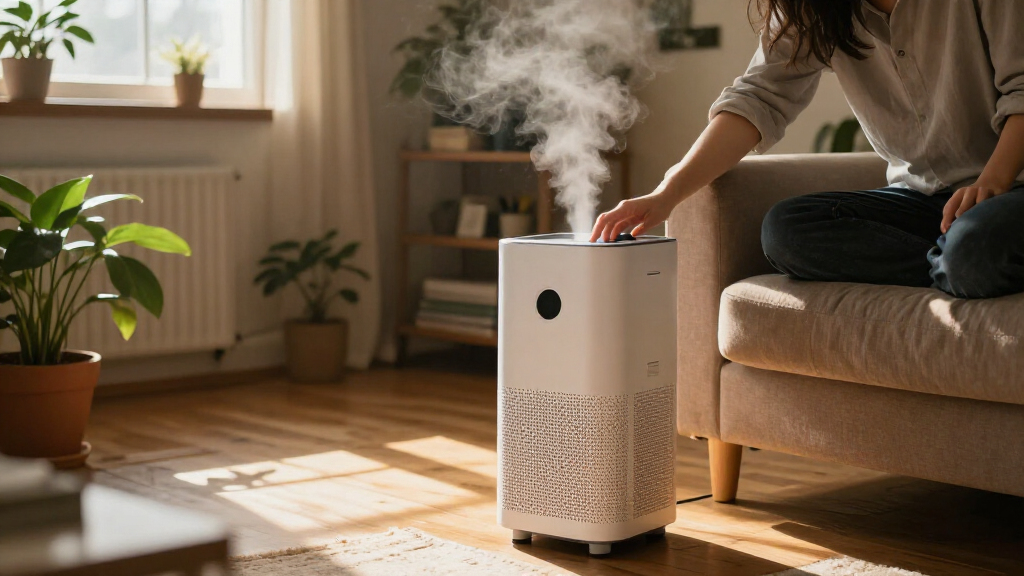

Choosing a whole-room humidifier is not just a question of tank size: the technology determines how the unit adds moisture, how much attention it needs, and what it leaves behind. Evaporative and ultrasonic models can both raise humidity in a room, but they suit different households. Evaporative humidifiers are usually the safer all-round choice for people who want more self-regulating moisture and less mineral residue. Ultrasonic models are appealing when quiet operation matters most and the owner is willing to use suitable water and clean the unit regularly. The practical decision is whether you value low-noise mist or a more forgiving, fan-driven approach to humidity control.

Get home appliances delivered free with Prime
- Fast, free delivery on millions of items
- Prime Video, Amazon Music and more included
- Member-only deals all year

DREO 11L Smart Humidifier Large Room 700 ft², 100H Runtime, 21dB Quiet 747S
- ✔ Tank capacity: 11 liters
- ✔ Claimed coverage: Up to 700 square feet
- ✔ Claimed runtime: Up to 100 hours

Levoit OasisMist 1000S (10L) Smart Humidifier for Home Large Room Bedroom
- ✔ Tank capacity: 10 liters
- ✔ Claimed coverage: Up to 600 square feet
- ✔ Claimed runtime: Up to 100 hours

Lacidoll 8L Large Humidifier for Bedroom Large Room Home 800 sq ft, Black
- ✔ Tank capacity: 8 liters (2.1 gallons)
- ✔ Claimed coverage: 500–800 square feet
- ✔ Claimed runtime: Up to 48 hours
At a Glance
| Criteria | Evaporative whole-room humidifiers | Ultrasonic whole-room humidifiers | Winner |
|---|---|---|---|
| Humidity control | Wick and fan add moisture; output tends to slow as room humidity rises. | Creates a cool mist; output depends on controls and the room’s ventilation. | A |
| Noise | Fan noise is audible, though some models offer low settings. | Usually very quiet because it does not rely on a large fan. | B |
| Mineral residue | Typically releases fewer minerals into the room; wick captures some mineral content. | Minerals in tap water can become fine white dust on nearby surfaces. | A |
| Maintenance | Wicks need periodic replacement, and the tank and base still need routine cleaning. | Requires regular cleaning; water quality and scale management matter. | Depends |
| Room coverage | Available in models for bedrooms through large living spaces; check rated coverage. | Coverage varies widely; match the rated area and output to the room. | Tie |
| Purchase and running value | Often a practical long-term choice, but replacement wicks add recurring cost. | Can cost less up front, but distilled water or extra cleaning may raise ongoing costs. | Depends |
| Household fit | Good for users seeking forgiving operation and less visible dust. | Good for noise-sensitive rooms and owners ready to manage water quality. | Depends |
DREO 11L Smart Humidifier Large Room 700 ft², 100H Runtime, 21dB Quiet 747S
The DREO 747S earns our top spot by combining the largest tank in this group with broad stated coverage and multiple ways to control it. Its 11-liter capacity and claimed runtime of up to 100 hours are particularly useful in a living room or open home office where stopping to refill every day would be inconvenient. The listed 700-square-foot coverage sits between Lacidoll’s larger 800-square-foot claim and Levoit’s 600-square-foot rating, while a mist plume described as reaching six feet is intended to distribute moisture above furniture rather than release it only at floor level.Compared with the Levoit OasisMist 1000S, DREO offers a slightly larger tank and app, remote, and voice controls, along with a claimed quieter operating figure. Levoit, however, specifies a 350 mL/h output, while the supplied DREO information does not give a comparable output rate, so we cannot use the listed coverage alone to determine which will humidify a particular room faster. Against the Lacidoll, DREO trades a little of the advertised coverage ceiling for a larger tank, longer claimed runtime, and more connected controls.The app and voice options make this the most flexible pick for households that want to adjust settings without crossing the room, and its auto mode uses a humidity sensor to modulate output. But the feature set adds complexity, and colorful lighting or connected controls may be unnecessary in a straightforward bedroom setup. Like the other ultrasonic models here, it still needs regular cleaning; its anti-scale filter and clean-tank features do not mean maintenance can be skipped. We rank it first for capacity and control flexibility, not because its 700-square-foot claim guarantees whole-home performance.
Pros:
- 11-liter tank is the largest listed in this comparison.
- Claims up to 100 hours of operation, reducing expected refill interruptions.
- App, remote, touch, and voice controls offer several ways to adjust settings.
- Auto mode, sleep mode, and a six-foot mist plume support flexible room use.
Cons:
- Its 700-square-foot coverage claim is lower than Lacidoll’s stated 800 square feet.
- The supplied specifications do not state a mist-output rate for direct comparison with Levoit or Lacidoll.
- App, voice controls, and RGB lighting may add complexity without value for buyers who want basic operation.
Best for: Households humidifying a large living room or open-plan space that want a large tank, automatic humidity adjustment, and app or voice access.
Not ideal for: Buyers who want a simple, non-connected device, need a published mist-output figure to compare performance, or expect one portable humidifier to serve multiple separated rooms.
Bottom line: Choose the DREO 747S when large tank capacity and connected automatic control matter more than a simpler setup or the highest stated coverage claim.
“Choose the DREO 747S when large tank capacity and connected automatic control matter more than a simpler setup or the highest stated coverage claim.”
Levoit OasisMist 1000S (10L) Smart Humidifier for Home Large Room Bedroom
The Levoit OasisMist 1000S is our pick for buyers who want a large-room humidifier that can fit into a repeatable routine. Its 10-liter tank and claimed 100-hour runtime put it close to the DREO on refill convenience, while its 600-square-foot coverage is more conservative than either competitor’s advertised maximum. Levoit also lists a 350 mL/h mist volume, giving buyers a concrete output figure that is absent from the DREO details supplied here. A mist height above five feet is intended to help moisture rise into the room, though furniture placement and room shape still affect distribution.The Vesync app supports schedules and customized settings, and the listed Auto, Plant, Aroma, and Sleep modes give this model a clear use case for people who want different operation patterns through the day. Compared with DREO, Levoit has a slightly smaller tank and fewer control methods specified in the product information, but its scheduled routines and stated output make its operating plan easier to evaluate. Compared with Lacidoll, it offers a longer claimed runtime and a larger tank, while Lacidoll claims wider coverage and provides a handheld remote.Top-fill access is a practical advantage: the wide opening is designed to make filling and cleaning easier than handling a sealed, awkward tank. Still, easy access is not the same as maintenance-free operation. The product information recommends distilled or purified water, and ultrasonic humidifiers can leave mineral deposits when used with mineral-rich water. We place Levoit second because it combines long stated runtime, useful scheduling, and a specified output rate, while its narrower coverage claim makes it a less obvious choice for the largest spaces in this group.
Pros:
- 10-liter tank and claimed runtime of up to 100 hours support extended operation between refills.
- Lists a 350 mL/h mist output and coverage up to 600 square feet.
- Vesync app scheduling and multiple modes support routine-based use.
- Wide top-fill opening is intended to simplify refilling and access for cleaning.
Cons:
- Its stated 600-square-foot coverage is the lowest of the three listed claims.
- The description specifies app and voice control, but does not list a handheld remote in the supplied features.
- Purified or distilled water is preferred, which may add an ongoing water-sourcing step.
Best for: Buyers with a room within the stated 600-square-foot range who want app-based schedules, a dedicated plant mode, and a clear mist-output specification.
Not ideal for: Shoppers prioritizing the broadest advertised coverage, a physical remote, or warm mist; this model is described as cool mist.
Bottom line: The OasisMist 1000S is the strongest fit when scheduled smart operation and plant-oriented modes matter more than the widest coverage claim.
“The OasisMist 1000S is the strongest fit when scheduled smart operation and plant-oriented modes matter more than the widest coverage claim.”
Lacidoll 8L Large Humidifier for Bedroom Large Room Home 800 sq ft, Black
The Lacidoll 8L stands out for the highest stated coverage in this comparison: up to 800 square feet, paired with a 300 mL/h mist output. That makes it worth considering for a large bedroom, office, or plant area where the buyer values a wide coverage claim and straightforward controls. It also includes adjustable humidity settings, three mist levels, a 360-degree nozzle, and a remote, so users can make basic changes without relying on a phone app. The top-fill design and removable tank are aimed at keeping refills and cleaning manageable.Its main tradeoff becomes clear beside the other two models. Lacidoll lists an 8-liter capacity and up to 48 hours of runtime, compared with the 10- and 11-liter tanks and claimed 100-hour runtimes of Levoit and DREO. It therefore asks for more frequent refills on paper. Its 300 mL/h output is also below Levoit’s listed 350 mL/h, even though Lacidoll claims the broader room coverage. That difference is a reminder to treat coverage numbers as manufacturer claims rather than promises of uniform humidity across a complex floor plan.For someone who wants app-based scheduling, DREO and Levoit offer more connected control. Lacidoll instead keeps the experience centered on its panel and remote, with a timer, sleep mode, and humidity adjustment. Its filter-free design avoids filter replacement, but filter-free does not mean care-free: the tank and water-contact surfaces still need regular cleaning. We rank it third because its coverage claim is appealing, yet its smaller capacity and shorter stated runtime make it less convenient for uninterrupted large-room use than the two 100-hour alternatives.
Pros:
- Claims coverage up to 800 square feet, the highest stated maximum in this lineup.
- Top-fill design, detachable tank, and remote support convenient everyday handling.
- Humidity adjustment from 45% to 95% and three mist levels allow manual tuning.
- Filter-free design avoids routine filter replacement.
Cons:
- Its 8-liter tank and up-to-48-hour runtime are smaller and shorter than the other two models’ listed figures.
- The listed 300 mL/h output is lower than Levoit’s 350 mL/h figure.
- The broad coverage claim should not be read as a guarantee of even humidity throughout a large or divided space.
Best for: Buyers who value a broad stated coverage range, a physical remote, adjustable humidity, and a top-fill design without app setup.
Not ideal for: People seeking the longest interval between refills, an app or voice-control system, or a published output rate higher than the Levoit’s listed 350 mL/h.
Bottom line: Choose Lacidoll for its high stated coverage and remote-based simplicity, but expect more frequent refills than with DREO or Levoit.
“Choose Lacidoll for its high stated coverage and remote-based simplicity, but expect more frequent refills than with DREO or Levoit.”
As an Amazon Associate we earn from qualifying purchases.
Key Differences
The central difference is how each type handles moisture and the byproducts of water. An evaporative unit draws air through a damp wick, then returns humidified air to the room. As humidity rises, evaporation naturally becomes less efficient, which can help limit over-humidification. An ultrasonic unit vibrates water into a mist. It can run quietly and deliver noticeable output, but it does not automatically stop adding moisture just because the room is already humid; a humidistat or attentive manual control helps.
Water quality is a major practical divider. Minerals from untreated tap water can pass into an ultrasonic mist and settle as white dust, especially near the unit. Evaporative wicks tend to retain some minerals, although they require replacement and can develop scale. Neither type is maintenance-free: both need regular cleaning, and stagnant water should not be left sitting in a dirty tank. For many households, evaporative is the less fussy choice; for a bedroom where fan noise is unacceptable, ultrasonic may be worth the added water and cleaning discipline.
Neither technology guarantees whole-room performance by itself. Coverage claims, output rate, room layout, ceiling height, air leaks, and the target humidity all matter. A correctly sized unit operated at a sensible humidity level is a better buy than a larger machine chosen on its label alone. If you need to humidify several separated rooms, one portable unit may not serve all of them evenly.
Detailed Comparison
Humidity control (Evaporative whole-room humidifiers wins — moderate)
Evaporative wins for forgiving control, by a moderate margin. Its output usually tapers as surrounding air becomes more humid, giving it a degree of self-limiting behavior. Ultrasonic units can provide adjustable output, and models with a reliable humidistat can manage levels well, but a basic mist unit may keep adding moisture unless the user turns it down or off. In either case, use a hygrometer or built-in humidity reading as a guide and avoid persistently excessive humidity, which can encourage condensation and mold.
Noise (Ultrasonic whole-room humidifiers wins — moderate)
Ultrasonic wins, often by a major practical margin for light sleepers. Its mist-making mechanism is generally quieter than the fan used by an evaporative model. The evaporative fan may be unobtrusive on a low setting, but it remains a source of steady sound. If the humidifier will run beside a bed, a nursery, or a quiet work area, ultrasonic is usually the stronger fit. If background fan noise is acceptable, this advantage matters less.
Mineral residue (Evaporative whole-room humidifiers wins — moderate)
Evaporative wins by a moderate to major margin when using hard tap water. Ultrasonic mist can carry dissolved minerals into the air, leaving pale dust on furniture and electronics. Distilled or demineralized water can reduce this problem, but adds expense and the burden of regular supply. Evaporative wicks capture some minerals, though they can accumulate scale and need replacement. For households that prefer tap water and minimal surface cleanup, evaporative is generally easier.
Maintenance (moderate difference)
The winner depends on which task you would rather manage. Evaporative models require wick checks and replacements, with frequency shaped by water quality and use. Ultrasonic models avoid a wick but need the tank and internal surfaces cleaned consistently, and scale can affect performance. This is a moderate difference rather than a clear victory: choose the kind of upkeep you are more likely to complete. Skipping cleaning is a poor plan for either type.
Room coverage (minor difference)
There is no technology-wide winner. Both types come in small-room and larger-capacity versions, so rated coverage and moisture output matter more than the label. A unit rated for a large open room may struggle in a drafty space or a home with high ceilings. Compare manufacturer coverage claims cautiously, then match the unit to the actual room and check whether it has adjustable output. The gap between individual models can be major; the difference between technologies is minor.
Purchase and running value (moderate difference)
Value depends on water and replacement costs, not only the shelf price. An ultrasonic model can be less expensive to buy, but distilled water and frequent descaling may erase that advantage. An evaporative unit can require replacement wicks, yet may be cheaper to operate if tap water is suitable and wick changes are infrequent. Before paying more, price the consumables and estimate how often the machine will run. The best value is the model whose ongoing requirements suit your household.
Household fit (moderate difference)
Ultrasonic suits noise-sensitive rooms; evaporative suits households prioritizing low residue and simpler humidity behavior. This is a meaningful but personal tradeoff. A quiet ultrasonic unit may be worth extra water handling for a bedroom. An evaporative model is usually a better default for shared living spaces, particularly where hard water and nearby furniture make mineral dust unwelcome. Consider the room, the water supply, and who will do the upkeep before choosing.
Evaporative whole-room humidifiers: Pros and Cons
Pros:
- Humidity output tends to taper as room humidity rises.
- Less likely to spread mineral dust when used with tap water.
- A sensible default for larger shared rooms when properly sized.
Cons:
- Fan noise may bother light sleepers or quiet-room users.
- Wicks need inspection and periodic replacement.
- Scale and residue can still build up in the wick and tank.
Ultrasonic whole-room humidifiers: Pros and Cons
Pros:
- Usually quieter than fan-driven evaporative models.
- No wick to replace.
- Offers adjustable mist output, with stronger control on models that include a humidistat.
Cons:
- Tap-water minerals can settle as white dust.
- Distilled water may add a recurring cost and supply chore.
- Needs consistent cleaning and attention to humidity settings.
Who Should Choose What
Choose Evaporative whole-room humidifiers if:
- You want a forgiving choice that naturally slows moisture output as the room becomes more humid.
- You plan to use tap water and want to reduce mineral dust on furniture.
- You can tolerate fan noise and prefer a wick-based approach.
Choose Ultrasonic whole-room humidifiers if:
- Quiet operation is the priority, especially near a bed or in a nursery.
- You can use distilled or demineralized water, or are comfortable cleaning mineral deposits.
- You want a wick-free design and will monitor humidity or use a model with a humidistat.
Skip both if: Skip portable room humidifiers if you need consistent humidity across many rooms or an entire building; consider a properly sized whole-home system or multiple room units instead.
Value for Money
Do not pay a premium for a technology label alone. An ultrasonic model is worth paying more for when quiet operation materially improves sleep or concentration, and the cost of suitable water and cleaning is acceptable. Its low purchase price is not a saving if you then avoid using it because filling it with distilled water is inconvenient.
An evaporative model is often better value for households using tap water, particularly if replacement wicks are affordable and easy to find. Check their price and availability before buying. A more expensive unit may justify its cost through a useful humidistat, easy-to-clean tank, suitable capacity, and reliable replacement parts—not merely a larger advertised room rating. For most users choosing between comparable models, evaporative is the safer value default; ultrasonic is the targeted upgrade for quiet.
Final Verdict
For most households, choose an evaporative whole-room humidifier. It offers a more forgiving approach to humidity and is less likely to spread tap-water minerals across the room, making it the better default when noise is not a deal-breaker. Choose an ultrasonic model when quiet operation is your top requirement and you are prepared to use appropriate water, clean it routinely, and monitor humidity. The biggest deciding factor is not which one claims more coverage; it is whether you would rather accept fan noise and wick replacement or manage water quality for quieter mist.
Frequently Asked Questions
Which type is better for a bedroom?
Ultrasonic is usually better when low noise is the main priority. If a quiet evaporative unit is available and a steady fan sound does not bother you, evaporative may be preferable for tap-water use and lower mineral residue. Check operating noise and controls for the specific model.
Can I use tap water in an ultrasonic humidifier?
Often you can, but minerals in tap water may become airborne and settle as white dust. Follow the manufacturer’s instructions; distilled or demineralized water can reduce residue. The choice involves an ongoing water cost or more surface cleanup.
Which humidifier is easier to maintain?
Neither is maintenance-free. Evaporative units need wick replacement as well as routine tank cleaning. Ultrasonic units skip the wick but still need regular cleaning and may need descaling. The easier choice depends on whether you prefer replacing a consumable or managing water deposits.
Do I need a humidistat?
A humidistat is useful on either type because it helps regulate operation toward a chosen humidity level. It is especially helpful with ultrasonic models, whose mist output does not naturally taper in the same way as evaporation. Verify that the sensor and controls suit the room; a separate hygrometer can also help you monitor conditions.