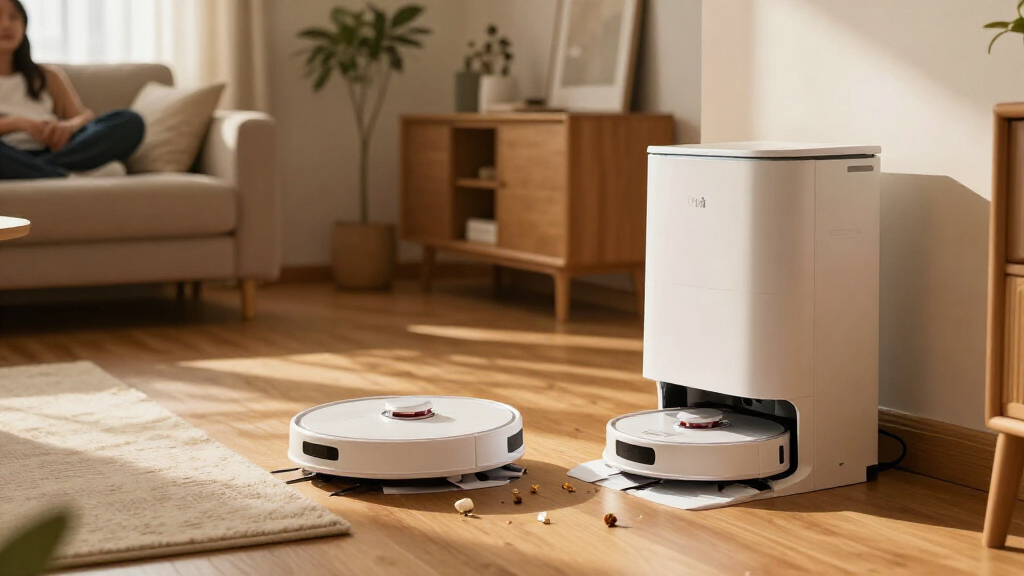
Robot vacuums with self-emptying stations reduce how often you need to empty the robot, but they differ in navigation, mopping, dock design, and upkeep. My best overall pick is the Roborock Q10 S5+, which pairs a self-emptying station with vacuum-and-mop capability; the Shark Navigator AV2110S is a simpler vacuum-focused alternative, while the iRobot Roomba 105 offers an AutoEmpty dock from a familiar brand. The main tradeoffs are how much automation you get, how much maintenance the dock still requires, and whether mopping adds useful convenience or extra work. A self-emptying base does not make a robot maintenance-free, and dock capacity and bag design can change the day-to-day experience. Read on for the full comparison and help matching a model to your home.

Get home appliances delivered free with Prime
- Fast, free delivery on millions of items
- Prime Video, Amazon Music and more included
- Member-only deals all year
Complete the kit


Key Takeaways
- Roborock Q10 S5+ leads the roundup because it combines a self-emptying station with vacuuming and mopping, making it the most balanced fit for buyers who want one robot for routine floor care.
- Shark Navigator AV2110S and Roomba 105 are more straightforward vacuum-focused choices; they suit shoppers who value a simpler cleaning setup over a mop function.
- Several listings combine vacuuming and mopping, but a mop attachment does not automatically mean hands-off floor washing; water handling and pad cleaning remain part of ownership.
- Dock styles vary: the iMartine D16S MAX uses a bagless self-emptying station, while other models use a self-emptying base. Buyers should check what emptying and dock upkeep involve before choosing.
- The lineup includes multiple less familiar brands and a broad range of feature claims, including the D17S MAX’s stated 12,000 Pa suction; compare the full maintenance and navigation setup rather than choosing by a single spec.
| Bagotte BL20 Pro Robot Vacuum and Mop Combo with Self-Emptying Station |  | Best for Long Self-Emptying Intervals | Model: BL20 Pro | Maximum suction: 10,000Pa | Navigation: 360° LiDAR | VIEW LATEST PRICE | See Our Full Breakdown |
| Tikom L8000 Plus Robot Vacuum and Mop with Self-Emptying Base |  | Best for Multi-Floor Mapping | Model: L8000 Plus | Maximum suction: 6,000Pa | Navigation and map storage: 360° LiDAR; up to five floor maps | VIEW LATEST PRICE | See Our Full Breakdown |
| iMartine D16S MAX Robot Vacuum and Mop with Bagless Self-Emptying Station |  | Best for High-Suction Cleaning | Model: D16S MAX | Maximum suction: 18,000Pa | Navigation and map storage: LiDAR; up to five floor maps | VIEW LATEST PRICE | See Our Full Breakdown |
| Shark Navigator Robot Vacuum with 30-Day Self-Emptying Base, White (AV2110S) |  | Best for Pet Hair and Bagless Upkeep | Model: AV2110S | Navigation: LiDAR SmartPath | Base type and capacity: Bagless self-emptying base; up to 30 days of debris | VIEW LATEST PRICE | See Our Full Breakdown |
| iRobot Roomba 105 Robot Vacuum with AutoEmpty Dock |  | Best for Long-Interval Bagged Emptying | Navigation: ClearView LiDAR | Dock: Bagged AutoEmpty dock; up to 75 days of debris storage | Cleaning system: Three-stage with multi-surface and edge-sweeping brushes | VIEW LATEST PRICE | See Our Full Breakdown |
| iRobot Roomba Plus 415X Robot Vacuum and Mop Combo |  | Best for Hands-Off Vacuuming and Mopping | Product type: Robot vacuum and mop combo | Suction power: 20,000 Pa | Cleaning modes: Vacuum-only, mop-only, vacuum and mop, vacuum then mop | VIEW LATEST PRICE | See Our Full Breakdown |
| Kilgone SDL40 Robot Vacuum and Mop with Self-Emptying Base |  | Best for Multi-Level Homes | Model: SDL40 | Cleaning functions: Vacuuming and sonic mopping | Navigation: LiDAR mapping | VIEW LATEST PRICE | See Our Full Breakdown |
| VONKO S6Pro Robot Vacuum and Mop with Self-Emptying Station |  | Best for Longer Cleaning Runs | Suction power: Up to 15,000 Pa | Navigation: LiDAR 2.0 | Mapping: Up to 5 floors | VIEW LATEST PRICE | See Our Full Breakdown |
| iRobot Roomba Max 715 Robot Vacuum with AutoEmpty Dock |  | Best for Pet Hair on Carpet | Product type: Robot vacuum | Dock: AutoEmpty dock with odor-control AllergenLock bag | Hands-free operation: Up to 90 days | VIEW LATEST PRICE | See Our Full Breakdown |
| Roborock Q10 S5+ Robot Vacuum and Mop with Self-Emptying Station |  | Best for Mixed Floors and App-Controlled Mopping | Maximum suction: 10,000 Pa | Dust bag capacity: 2.7 L | Dust bag maintenance interval: Up to 70 days | VIEW LATEST PRICE | See Our Full Breakdown |
| D17S MAX Robot Vacuum and Mop with 12,000 Pa Suction and Self-Emptying Base | 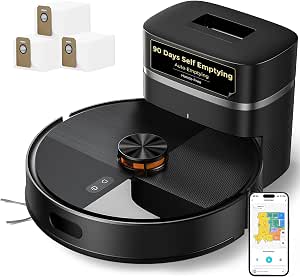 | Best for Multi-Floor Mapping | Suction power: Up to 12,000 Pa | Navigation: dToF LiDAR | Map storage: Up to 5 maps | VIEW LATEST PRICE | See Our Full Breakdown |
| robot vacuums with self emptying | Navigation |
|---|---|
| Bagotte BL20 Pro Robot Vacuum | 360° LiDAR |
| Tikom L8000 Plus Robot Vacuum | — |
| iMartine D16S MAX Robot Vacuum | — |
| Shark Navigator Robot Vacuum w | LiDAR SmartPath |
| iRobot Roomba 105 Robot Vacuum | ClearView LiDAR |
| iRobot Roomba Plus 415X Robot | LiDAR mapping and obstacle recognition |
| Kilgone SDL40 Robot Vacuum and | LiDAR mapping |
| VONKO S6Pro Robot Vacuum and M | LiDAR 2.0 |
| iRobot Roomba Max 715 Robot Va | ClearView Pro LiDAR with 3D mapping |
| Roborock Q10 S5+ Robot Vacuum | LiDAR with 360° scanning and multi-level mapping |
| D17S MAX Robot Vacuum and Mop | dToF LiDAR |
More Details on Our Top Picks
Bagotte BL20 Pro Robot Vacuum and Mop Combo with Self-Emptying Station
The Bagotte BL20 Pro is a strong fit for buyers who want vacuuming, mopping, and a sizable debris station in one machine. Its station is designed to hold up to 90 days of debris, the longest stated interval among these five picks, so it may suit homes where frequent dock maintenance is unwelcome. LiDAR mapping, room scheduling, and no-go zones also give it more control than a basic set-and-forget robot. Compared with the Tikom L8000 Plus, Bagotte claims higher suction and a longer debris-handling interval, while Tikom offers saved maps for up to five floors and dual-band Wi-Fi. The tradeoff is connectivity: Bagotte supports 2.4GHz Wi-Fi only, and its listed carpet coverage stops at low- to mid-pile. Its two-year warranty and lifetime technical support add reassurance, but do not remove those fit limits.
Pros:- Station is designed to store up to 90 days of debris.
- Combines vacuuming, sweeping, mopping, and self-emptying.
- LiDAR mapping supports room navigation, scheduling, and no-go zones.
- App, push-button, and voice controls provide several ways to manage cleaning.
Cons:- Wi-Fi compatibility is limited to 2.4GHz networks.
- Listed carpet recommendations cover only low- to mid-pile carpets.
Best for: Households seeking a vacuum-and-mop robot with a large debris station and scheduled room cleaning, especially those with hard floors and low- to mid-pile rugs.
Not ideal for: Homes with thick or high-pile carpet, or buyers whose home network depends on 5GHz Wi-Fi.
- Model:BL20 Pro
- Maximum suction:10,000Pa
- Navigation:360° LiDAR
- Station dust capacity:3 liters; designed for up to 90 days of debris
- Battery life:Up to 160 minutes
- Cleaning functions:Vacuuming, sweeping, mopping, and self-emptying
- Wi-Fi compatibility:2.4GHz only
- Warranty and support:Two-year warranty; lifetime technical support
Our verdict“Choose the Bagotte BL20 Pro if a long stated interval between debris handling matters more than 5GHz Wi-Fi or support for thicker carpet.”
Tikom L8000 Plus Robot Vacuum and Mop with Self-Emptying Base
The Tikom L8000 Plus makes the most sense for a multi-level home where saved maps matter as much as the self-emptying base. Its 360° LiDAR can store up to five floor maps, and room selection, no-go zones, and no-mop zones let users tailor cleaning by area. Auto-recharge and resume help it finish larger jobs without requiring a manual restart. Compared with the Bagotte BL20 Pro, Tikom offers 2.4GHz and 5GHz Wi-Fi and a stated 3-liter dustbag, but its maximum suction is lower and its listed runtime reaches 150 minutes only in gentle suction mode. The mop also needs planning around carpets: users must remove the holder or set a no-mop zone to keep carpet dry. This is a practical mapping-focused pick, not the simplest choice for someone who wants to run mop mode without setup.
Pros:- Stores up to five floor maps for multi-level homes.
- 3-liter dustbag reduces how often debris needs attention.
- Automatically recharges and resumes cleaning when needed.
- Supports adjustable suction, water flow, no-go zones, and no-mop zones.
Cons:- Mop mode requires removing the mop holder or setting a no-mop zone around carpets.
- The up-to-150-minute runtime is specified for gentle suction mode.
Best for: Owners of multi-story homes who want separate saved maps, room-level schedules, and automatic recharge-and-resume cleaning.
Not ideal for: Buyers who want mop mode to work around carpets without removing the mop holder or setting restricted zones.
- Model:L8000 Plus
- Maximum suction:6,000Pa
- Navigation and map storage:360° LiDAR; up to five floor maps
- Dustbag capacity:3 liters
- Runtime:Up to 150 minutes in gentle suction mode
- Cleaning functions:Vacuuming, mopping, and self-emptying
- Wi-Fi compatibility:2.4GHz and 5GHz
- Filter:HEPA
Our verdict“Pick the Tikom L8000 Plus if you need saved maps for several floors and are willing to manage carpet boundaries when mopping.”
iMartine D16S MAX Robot Vacuum and Mop with Bagless Self-Emptying Station
The iMartine D16S MAX is the suction-focused choice here, with a listed maximum of 18,000Pa and four cleaning levels for mixed floors. It combines that headline figure with LiDAR maps for up to five floors and a bagless self-emptying station, making it appealing to buyers who want strong stated suction without a dock dustbag. Compared with the Shark Navigator AV2110S, iMartine adds mopping and multi-floor map storage, while Shark specifies an anti-hair-wrap brushroll and object-avoidance sensors. The iMartine station’s 1.3-liter container is smaller than the 3-liter stations listed for Bagotte and Tikom, so it may need more frequent attention. Its app and voice features also require 2.4GHz Wi-Fi, and one filter component is not washable. The high suction figure is attractive, but the smaller container is a meaningful tradeoff for a self-emptying model.
Pros:- Lists up to 18,000Pa suction with four cleaning levels.
- Bagless self-emptying station avoids the need for dustbags.
- LiDAR mapping stores up to five floor maps.
- Combines vacuuming and mopping with three water-flow settings.
Cons:- The 1.3-liter station container is smaller than the 3-liter stations listed for Bagotte and Tikom.
- App and voice-control features require 2.4GHz Wi-Fi.
- Filter cotton is not washable.
Best for: Buyers prioritizing high stated suction, adjustable cleaning levels, and bagless debris collection across several mapped floors.
Not ideal for: Households wanting a large-capacity self-emptying station or washable components throughout the filtration system.
- Model:D16S MAX
- Maximum suction:18,000Pa
- Navigation and map storage:LiDAR; up to five floor maps
- Self-emptying container:1.3 liters; bagless
- Water tank:150ml with three flow settings
- Battery life:Up to 180 minutes
- Cleaning path width:12 inches
- Wi-Fi requirement:2.4GHz
Our verdict“Choose the iMartine D16S MAX if high stated suction and a bagless dock matter more to you than a larger debris container.”
Shark Navigator Robot Vacuum with 30-Day Self-Emptying Base, White (AV2110S)
The Shark Navigator AV2110S is the clearest fit for buyers who want a self-emptying robot focused on vacuuming rather than mopping. Its bagless base holds up to 30 days of debris, while the self-cleaning anti-hair-wrap brushroll is aimed at reducing hair buildup during routine use. LiDAR SmartPath maps rooms for row-by-row cleaning, and object-avoidance sensors give it a more hands-off profile than a basic mapping-only model. Compared with the iRobot Roomba 105, Shark specifies a bagless base and anti-hair-wrap brushroll; Roomba instead lists a bagged dock with storage for up to 75 days and allergen filtration details. Shark’s stated 30-day interval is shorter, and its 0.21-quart onboard dustbin is small. Buyers also need the SharkClean app for scheduling and customization, so this is less appealing to anyone seeking a mop or broad control options outside the app.
Pros:- Bagless base is designed to hold up to 30 days of debris.
- Self-cleaning anti-hair-wrap brushroll targets hair buildup.
- LiDAR SmartPath supports mapped, row-by-row cleaning.
- Automatically recharges and resumes cleaning.
Cons:- The onboard dustbin capacity is 0.21 quarts.
- The stated base storage interval is shorter than the Roomba 105’s up-to-75-day figure.
- Scheduling and customization rely on the SharkClean app.
Best for: Pet owners who want a bagless self-emptying vacuum, hair-focused brushroll design, and mapped cleaning for carpet and hard floors.
Not ideal for: Buyers who need mopping, a longer stated debris-storage interval, or cleaning customization without relying on the SharkClean app.
- Model:AV2110S
- Navigation:LiDAR SmartPath
- Base type and capacity:Bagless self-emptying base; up to 30 days of debris
- Brushroll:Self-cleaning with anti-hair wrap
- Onboard dustbin:0.21 quarts
- Battery life:Up to 120 minutes
- Surfaces:Carpet and hard floors
- Controls:SharkClean app; Amazon Alexa and Google Voice
Our verdict“Choose the Shark Navigator AV2110S for bagless, pet-hair-focused vacuuming, but skip it if mopping or a longer stated dock interval is a priority.”
iRobot Roomba 105 Robot Vacuum with AutoEmpty Dock
The iRobot Roomba 105 suits buyers who want a vacuum-only robot with a long stated interval between dock maintenance. Its bagged AutoEmpty dock stores debris for up to 75 days, and the three-stage system targets carpets and hard floors with a multi-surface brush and edge-sweeping brush. ClearView LiDAR supports home mapping, while app, button, and compatible voice controls allow scheduled, targeted, and spot cleaning. Compared with the Shark Navigator AV2110S, Roomba lists a longer debris-storage interval and allergen filtration, whereas Shark’s bagless base may appeal to people who prefer not to replace dock bags and it adds an anti-hair-wrap brushroll. Roomba’s stated 2.4GHz Wi-Fi requirement may limit setup options, and a bagged dock brings consumable bags into the upkeep routine. This is a more focused vacuum pick than the mop-capable Bagotte or Tikom.
Pros:- Bagged AutoEmpty dock stores debris for up to 75 days.
- ClearView LiDAR supports home mapping and targeted cleaning.
- Three-stage cleaning system includes multi-surface and edge-sweeping brushes.
- Controls include the app, robot buttons, and compatible voice assistants.
Cons:- Wi-Fi setup and operation require a 2.4GHz network.
- The bagged dock requires replacement bags.
- It does not include mopping, unlike the Bagotte BL20 Pro and Tikom L8000 Plus.
Best for: Households wanting mapped daily vacuuming and a bagged dock with a long stated debris-storage interval, plus app, button, and voice controls.
Not ideal for: Buyers seeking mopping, bagless debris disposal, or Wi-Fi operation on a 5GHz-only network.
- Navigation:ClearView LiDAR
- Dock:Bagged AutoEmpty dock; up to 75 days of debris storage
- Cleaning system:Three-stage with multi-surface and edge-sweeping brushes
- Battery life:Up to 200 minutes
- Cleaning path width:5.8 inches
- Allergen filtration:Traps 99% of allergens as small as 0.7 microns
- Wi-Fi:2.4GHz
- Compatible voice assistants:Alexa, Siri, and Google Assistant
Our verdict“Pick the Roomba 105 if you want mapped vacuuming with a long stated bagged-dock interval and do not need a mop.”
iRobot Roomba Plus 415X Robot Vacuum and Mop Combo
The Roomba Plus 415X is the strongest fit here for buyers who want the dock to handle more than dust: its AutoWash Dock empties debris, washes mop pads, and heat-dries them at 113°F. That upkeep can mean less handling of dirty pads than with the VONKO S6Pro, whose listed station focuses on debris emptying. Four cleaning modes also let you separate vacuuming from mopping or run both together, while 20,000 Pa suction, LiDAR, and obstacle recognition support a more feature-rich routine. The tradeoff is that an all-in-one dock still needs water refills and maintenance, so it is not a fully hands-off appliance. Its 10 mm mop lift helps clear some rugs, but higher-pile carpet may still be a poor match.
Pros:- AutoWash Dock combines debris emptying with mop-pad washing and heat drying.
- Four cleaning modes allow vacuuming and mopping routines to be separated or combined.
- LiDAR navigation and obstacle recognition support mapped cleaning around household objects.
- Tangle-free rubber brushes are designed to reduce hair wrap.
Cons:- The dock still needs water refills and maintenance.
- A 10 mm mop lift may not clear higher-pile rugs.
- Mop-pad washing and drying add dock complexity compared with a vacuum-only self-emptying setup.
Best for: Households with a mix of hard floors and low-pile rugs that want the dock to wash and dry mop pads as well as empty debris.
Not ideal for: Homes with high-pile rugs or buyers who want a dock that needs little attention beyond replacing or emptying a dust container.
- Product type:Robot vacuum and mop combo
- Suction power:20,000 Pa
- Cleaning modes:Vacuum-only, mop-only, vacuum and mop, vacuum then mop
- Dock:AutoWash Dock with debris emptying, mop-pad washing, and heat drying
- Debris emptying:Up to 90 days
- Mop-pad drying temperature:113°F
- Mop lifting height:10 mm
- Navigation:LiDAR mapping and obstacle recognition
- Controls:App and voice control
Our verdict“Choose the Roomba Plus 415X if mop-pad washing and drying matter as much as automatic debris emptying, and your rugs are not too tall.”
Kilgone SDL40 Robot Vacuum and Mop with Self-Emptying Base
The Kilgone SDL40 makes the most sense for homes where one robot needs to remember several layouts: it supports up to five maps, automatically recharges, and resumes a cleaning run. Its 2.5 L bag is rated for up to 90 days of debris, matching the longer emptying interval claimed for the Roomba Max 715, though the Roomba is a vacuum-only choice with more specified obstacle features. Kilgone adds sonic mopping for mixed floors, but its 300 ml water tank may call for refills during larger jobs. The 150-minute runtime and LiDAR mapping suit broader cleaning routes, while app control is required for connected functions. Compared with the Roborock Q10 S5+, Kilgone offers more stated map capacity, but provides less detail about its mopping system and obstacle avoidance.
Pros:- Stores up to five floor plans for homes with multiple levels or layouts.
- Automatic recharge and resume can carry longer cleaning jobs through to completion.
- A 2.5 L dust bag is designed for up to 90 days between emptying.
- Combines vacuuming with sonic mopping and anti-tangle brushes.
Cons:- The 300 ml water tank may need refilling during larger mopping sessions.
- Connected features require Wi-Fi setup and app control.
- The product details provide less information about obstacle avoidance than the Roomba Max 715.
Best for: People with multiple floors or separate home layouts who want mapped cleaning, automatic recharge and resume, and a self-emptying bag.
Not ideal for: Buyers who want detailed obstacle-avoidance functions, or households that prefer not to set up and manage cleaning through an app.
- Model:SDL40
- Cleaning functions:Vacuuming and sonic mopping
- Navigation:LiDAR mapping
- Dust bag capacity:2.5 L
- Dust bag claim:Up to 90 days
- Runtime:Up to 150 minutes
- Mapping capacity:Up to 5 maps
- Water capacity:300 ml
- Connectivity:2.4 GHz and 5 GHz Wi-Fi; app control
Our verdict“Pick the Kilgone SDL40 if multi-map support and recharge-and-resume matter more to you than a more fully specified obstacle-avoidance system.”
VONKO S6Pro Robot Vacuum and Mop with Self-Emptying Station
With a stated 180-minute runtime and mapping for as many as five floors, the VONKO S6Pro is aimed at larger homes where a cleaning session may cover several rooms before the robot needs charging. Its 2.5-liter station is rated for up to 60 days between manual emptying, a shorter interval than the 90-day claims for the Kilgone SDL40 and Roomba Max 715. In exchange, VONKO combines vacuuming and mopping, lists up to 15,000 Pa suction, and supports app and Alexa control. Mopping is intended for hard floors, so carpeted rooms benefit mainly from the vacuum function; the station also needs dedicated floor space. This is a capable fit for multi-floor homes, but not the pick for buyers who prioritize the longest stated dust-bag interval.
Pros:- Up to 180 minutes of runtime suits longer cleaning sessions.
- LiDAR mapping supports layouts across up to five floors.
- The 2.5-liter station is rated for up to 60 days between manual emptying.
- Combines vacuuming and mopping with app and Alexa control.
Cons:- Mopping is intended for hard floors, limiting its use in carpeted rooms.
- The station requires dedicated space in the home.
- Its stated 60-day emptying interval is shorter than the claims for the Kilgone SDL40 and Roomba Max 715.
Best for: Owners of larger, multi-floor homes who want long runtime, editable LiDAR maps, and a combined vacuum-and-mop robot.
Not ideal for: Homes with mostly carpet, limited space beside a wall for the station, or buyers seeking a stated 90-day interval between emptying.
- Suction power:Up to 15,000 Pa
- Navigation:LiDAR 2.0
- Mapping:Up to 5 floors
- Runtime:Up to 180 minutes
- Self-emptying station capacity:2.5 liters
- Hands-free maintenance:Up to 60 days
- Cleaning functions:Vacuuming and mopping
- Controls:App control; Alexa compatible
Our verdict“Choose the VONKO S6Pro for long runs and multi-floor mapping, but skip it if carpet mopping or the longest emptying interval is your priority.”
iRobot Roomba Max 715 Robot Vacuum with AutoEmpty Dock
The Roomba Max 715 is the clearest choice in this group for buyers who want self-emptying vacuum care without adding mop upkeep. Its anti-tangle dual rubber brushes, carpet-boosted suction, and targeted repeat cleaning are geared toward pet hair and heavier everyday messes on carpet and hard floors. ClearView Pro LiDAR and PrecisionVision obstacle recognition help it map rooms and work around objects, giving it a more explicitly described avoidance system than the Kilgone SDL40. The AutoEmpty dock stores debris in an odor-control bag for up to 90 days, though that bag still needs periodic replacement. Unlike the Roomba Plus 415X, this is not a mop combo; that keeps the routine simpler but leaves hard-floor mopping to another tool. Voice control also depends on a compatible assistant device.
Pros:- Anti-tangle dual rubber brushes are designed to reduce hair wrap.
- Carpet Boost increases suction on carpets and rugs.
- LiDAR mapping and obstacle recognition support room-based cleaning around objects.
- Odor-control AutoEmpty bag stores debris for up to 90 days.
Cons:- The dock bag needs replacement periodically, with the product data estimating about four times per year.
- It does not mop, unlike the Roomba Plus 415X and Roborock Q10 S5+.
- Voice control requires a compatible Alexa, Siri, or Google Assistant device.
Best for: Pet owners with carpet and hard floors who want mapped, targeted vacuuming and a long interval between debris disposal.
Not ideal for: Buyers who need mopping, want to avoid replacement dust bags, or lack a compatible voice-assistant device for voice control.
- Product type:Robot vacuum
- Dock:AutoEmpty dock with odor-control AllergenLock bag
- Hands-free operation:Up to 90 days
- Brushes:Anti-tangle dual rubber brushes and edge-sweeping brush
- Suction:4X more power-lifting suction compared with Roomba 105 Robot
- Navigation:ClearView Pro LiDAR with 3D mapping
- Obstacle avoidance:PrecisionVision AI Technology
- Floor types:Carpets and hard floors
- Voice compatibility:Alexa, Siri, and Google Assistant
Our verdict“Choose the Roomba Max 715 if pet hair and carpet-focused vacuuming matter more than having an onboard mop.”
Roborock Q10 S5+ Robot Vacuum and Mop with Self-Emptying Station
The Roborock Q10 S5+ stands out for combining a large dust bag with active mopping and carpet-aware features. Its 2.7 L bag is rated for up to 70 days between maintenance, landing between the VONKO S6Pro at up to 60 days and the 90-day claims from the Roomba Max 715 and Kilgone SDL40. The differentiator is the VibraRise 2.0 sonic mop, which makes up to 3,000 scrubs per minute, alongside carpet detection and an 8 mm mop lift. That setup gives mixed-floor homes more flexibility than a vacuum-only robot, though taller rugs may still pose a problem. LiDAR mapping and structured-light obstacle avoidance add navigation tools, but Wi-Fi is limited to 2.4 GHz, and the listed cleaning time is up to 150 minutes.
Pros:- A 2.7 L dust bag is rated for up to 70 days between maintenance.
- Sonic mopping delivers up to 3,000 scrubs per minute.
- Carpet detection and an 8 mm mop lift support mixed-floor cleaning.
- LiDAR mapping, obstacle avoidance, and multi-level mapping aid scheduled cleaning.
Cons:- Wi-Fi support is limited to 2.4 GHz.
- The 8 mm mop lift may not clear taller rugs.
- The stated cleaning time is up to 150 minutes.
Best for: Households with hard floors, tile, and low-pile carpet that want sonic mopping, carpet detection, and a roomy self-emptying bag.
Not ideal for: Homes with high-pile rugs or buyers whose network depends on 5 GHz Wi-Fi.
- Maximum suction:10,000 Pa
- Dust bag capacity:2.7 L
- Dust bag maintenance interval:Up to 70 days
- Battery life:150 minutes
- Mopping system:VibraRise 2.0 dual-zone sonic vibration; up to 3,000 scrubs per minute
- Carpet mop lift:Up to 8 mm
- Navigation:LiDAR with 360° scanning and multi-level mapping
- Obstacle avoidance:ReactiveTech structured light
- Wi-Fi:2.4 GHz only
Our verdict“Pick the Roborock Q10 S5+ if you want a self-emptying robot that adds active mopping and carpet-aware handling for mixed floors.”
D17S MAX Robot Vacuum and Mop with 12,000 Pa Suction and Self-Emptying Base
The D17S MAX pairs a self-emptying base with vacuum-and-mop cleaning, making it a flexible pick for homes where floors need different routines. Its dToF LiDAR mapping stores up to five maps and supports room cleaning and no-go zones, a practical advantage for multi-level households compared with the more straightforward Shark Navigator AV2110S, which is vacuum-only. Strong advertised suction and automatic carpet boost add appeal across mixed flooring, while adjustable water flow lets you tailor mopping on hard surfaces.
The tradeoff is that the 160-minute runtime is specified for quiet mode, so intensive cleaning may require a recharge-and-resume cycle. Carpet boost is also conditional on detecting carpet over 10 mm. The base handles debris emptying, but the robot’s listed 250 ml dustbox and 300 ml water tank still limit onboard capacity during a run. I’d choose it for mapping flexibility, not for a hands-off mop-washing system.
Pros:- Self-emptying base reduces the need to empty the robot’s dustbox after each cleaning run.
- Stores up to five LiDAR maps and supports no-go zones and room-specific cleaning.
- Vacuum-and-mop operation includes adjustable suction and electronic water-flow settings.
- Recharge-and-resume support helps it cover larger areas across multiple runs.
Cons:- The advertised runtime of up to 160 minutes applies to quiet mode.
- Carpet boost activates when carpet detected is over 10 mm, which may not suit every rug.
- The 250 ml dustbox and 300 ml water tank may require attention during larger cleaning jobs.
Best for: Multi-level households with a mix of hard floors and carpets that want saved maps, scheduled vacuuming, and basic mopping in one robot.
Not ideal for: Buyers who want a fully automated mop-care system, or homes with thick carpets that need carpet boost on shorter-pile rugs.
- Suction power:Up to 12,000 Pa
- Navigation:dToF LiDAR
- Map storage:Up to 5 maps
- Runtime:Up to 160 minutes in quiet mode
- Battery:3200 mAh lithium-ion, 14.4 V
- Dustbox capacity:250 ml
- Water tank capacity:300 ml
- Cleaning path width:6.3 inches
- Controls:App, buttons, Alexa, and Google Assistant
Our verdict“Choose the D17S MAX if saved maps across several floors and combined vacuuming and mopping matter more than automated mop maintenance.”
How We Picked
I compared the 11 listed models on the factors that shape ownership of a self-emptying robot: how the robot cleans, what the dock does after a run, whether the model also mops, and how much routine care its setup implies. I also considered the difference between vacuum-only picks and combo models, dock design, and how clearly a product’s stated features help a buyer predict its day-to-day role. A higher suction figure alone does not settle the ranking; navigation, usability, and the amount of work left for the owner matter too.
The Roborock Q10 S5+ ranks first as a balanced vacuum-and-mop option with a self-emptying station. The Shark Navigator AV2110S and Roomba 105 follow as clearer fits for buyers who want vacuuming and automatic dirt disposal without adding a mop routine. Other combo models earn consideration for their stated features or dock approach, but their position depends on how well those details fit a buyer’s priorities. I treat model names and advertised specifications as starting points, not proof of cleaning results, and call out tradeoffs rather than assuming every extra feature is an advantage.
Factors to Consider When Choosing Robot Vacuums With Self Emptying
A self-emptying dock can cut down on one repetitive chore, but the best choice depends on what still needs your attention after a cleaning run. I would start with the home’s floor mix and cleaning routine, then compare dock upkeep, navigation needs, and the practical limits of mopping.
Decide What You Want the Dock to Empty
Self-emptying most often refers to debris moving from the robot’s bin into a larger dock container; it does not mean the robot or station needs no care. Check whether the dock uses a replaceable bag or a bagless container, since those options change how you handle dust and ongoing supplies. A bag can contain debris during disposal, while a bagless design avoids replacing bags but still needs the container emptied and cleaned. Also check whether the advertised storage period assumes light use, because pet hair, larger homes, and frequent schedules can fill a dock sooner. A common mistake is treating a stated number of days as a guarantee for every household. Choose the setup whose emptying routine you are actually willing to maintain.
Match Vacuuming and Mopping to Your Floors
A combo robot can be useful on homes with both hard floors and rugs, but the mop function adds its own chores. You may need to fill a water reservoir, attach or wash pads, and prevent damp cleaning across rugs or sensitive flooring. If most of your home is carpet, a vacuum-only model such as the Shark Navigator or Roomba 105 may be a better fit than paying attention to a mop feature you rarely use. For mixed floors, check how the robot handles rug boundaries and whether the mop setup suits your routine. Do not assume that a mop attachment replaces manual spot cleaning or pad care. Buy a combo for the floors you have, not simply because it has more features.
Prioritize Navigation for Your Floor Plan
Navigation affects whether a robot can clean a whole home in a useful pattern or repeatedly miss awkward areas. Open layouts may be forgiving, while crowded rooms, narrow passages, and multiple thresholds ask more of a robot’s mapping and obstacle handling. Before choosing, note where cords, toys, low furniture, and rugs tend to collect; these obstacles can matter more than a headline suction figure. A self-emptying dock cannot compensate for a robot that struggles to reach the places you want cleaned. Check how the model supports scheduled cleaning and room selection if you expect to send it to particular areas. If your home is complex, place greater weight on navigation details than on add-on features.
Treat Suction Claims as One Part of Cleaning
Suction numbers can help distinguish stated specifications, but they do not describe the entire cleaning experience. Brush design, floor type, debris pickup, navigation, and how well the robot reaches edges also affect results. The D17S MAX advertises 12,000 Pa suction, yet that figure alone does not tell you how it will perform across your particular rugs or floor plan. A buyer focused on pet hair should also think about brush tangles and how easy the bin and brushes are to clear. For hard floors, coverage and reliable routine scheduling may matter more than chasing the largest number. Compare the whole cleaning system rather than selecting by suction alone.
Account for the Space and Upkeep a Station Needs
A self-emptying station is larger than a basic charging dock, so measure the intended spot before ordering. Leave enough open space for the robot to approach and leave the base, and check that the dock can sit near an outlet without blocking a walkway or cupboard. Think about sound as well: the emptying cycle can be louder than the robot’s normal cleaning, which may affect when you schedule it. The station also needs access for removing its bag or debris container and cleaning around the intake. Buyers sometimes focus on where the robot will clean and forget where its dock will live. A convenient dock location makes daily use easier and lowers the odds that the robot gets stranded.
Pay for Features You Will Use Regularly
More features can add flexibility, but they can also bring more parts to maintain and more settings to learn. A vacuum-only model may be the more sensible purchase for someone who wants scheduled debris pickup, while a combo makes more sense when routine hard-floor mopping will genuinely save time. Compare the dock type, robot functions, and maintenance tasks as a package rather than treating the station as the only deciding factor. Also check what consumables the model requires, including bags and replacement cleaning parts, before settling on a setup. If this is your first robot vacuum, a simpler feature set may be easier to manage than a model with functions you rarely use. Spend extra attention on convenience only when it removes a chore you currently do often.
Frequently Asked Questions
Does a self-emptying robot vacuum still need regular maintenance?
Yes. The dock reduces how often you empty the robot’s small dust bin, but you still need to replace a bag or empty a bagless container and clean the robot’s brushes, sensors, and other accessible parts. Combo models add water and mop-pad care. The right schedule depends on how often the robot runs and what it picks up, especially if your home has pets or heavy debris. Think of self-emptying as less frequent bin handling, not a maintenance-free system.
Should I choose a bagged or bagless self-emptying station?
Choose based on the disposal routine you prefer. Bagged stations contain debris in a removable bag, which can make disposal tidier, but you need compatible replacement bags. A bagless station avoids that consumable but requires you to empty and clean its container yourself. Dust sensitivity, storage for spare supplies, and how often you expect to empty the dock can all influence the decision. Check the exact dock design for the model you are buying rather than assuming every self-emptying base works the same way.
Is a robot vacuum and mop combo worth it if I have rugs?
It can be, if you also have hard floors and the robot can fit the mop routine around your rugs. A combo still requires you to manage the water and mop pad, and you should check how the model handles carpet boundaries before relying on it in mixed-floor rooms. If most of your home is carpet, a vacuum-focused option such as the Shark Navigator AV2110S or Roomba 105 may be simpler. For mostly hard floors, a combo can add a useful regular-cleaning task. The key is whether you will use the mop often enough to justify its extra upkeep.
Will a self-emptying robot vacuum work well in a home with pets?
It may reduce frequent bin emptying when a robot collects pet hair, but results depend on brush design, floor type, navigation, and how much hair your home produces. Hair can still wrap around brushes or collect in other parts that require hands-on cleaning. Check the model’s maintenance instructions and make room in your routine for clearing tangles. A larger dock can also fill faster than an advertised interval in a home with multiple shedding pets. Choose for the full hair-handling routine, not just the self-emptying feature.
How much space should I set aside for a self-emptying dock?
Plan for the dock itself and enough clear floor area for the robot to approach, turn, and leave without obstruction. Measure the chosen spot, check the station dimensions, and account for a nearby outlet before buying. Keep the dock accessible so you can remove a bag or debris container and clean around it. Avoid a location where doors, furniture, or daily foot traffic can block the robot’s return path. If the dock has no practical home, a smaller or simpler setup may fit your routine better.
Conclusion
For most buyers seeking one machine for routine vacuuming and mopping, I recommend the Roborock Q10 S5+ as the best overall fit in this lineup. The Bagotte BL20 Pro, Tikom L8000 Plus, and other combo models are worth comparing as value-oriented alternatives, but choose based on the dock and upkeep details that suit your home rather than feature counts alone. For a best premium direction, consider the iRobot Roomba Max 715 if you prefer a Roomba vacuum with an AutoEmpty dock; for a simpler first robot, the Roomba 105 or Shark Navigator AV2110S avoids adding mop care. The iMartine D16S MAX is the distinct pick for shoppers who specifically want a bagless self-emptying station, while the D17S MAX may appeal to those comparing a high stated suction figure. My final choice would come down to whether your priority is balanced floor care, simpler vacuuming, or a particular dock style—and how much maintenance you want to handle.