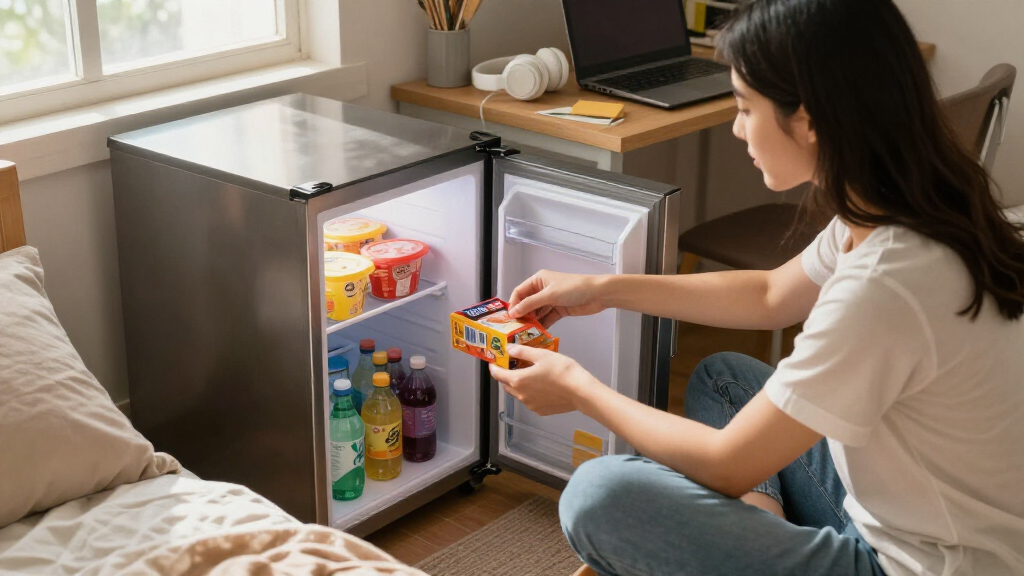

A compact dorm room mini fridge needs to hit a narrow target: small enough for a cramped room, quiet enough for sleep and study, and big enough to actually hold a week’s worth of snacks and drinks. The Sweetcrispy 3.2 Cu.Ft 2-Door earns the best overall spot here because its separate freezer door avoids the temperature-swing problems that plague single-door models, while staying dorm-friendly in size and noise. If floor space is the limiting factor, the Upstreman 1.7 Cu.ft is the standout small-format pick, and the Midea 1.6 Cu.ft is the budget choice for anyone who mostly needs cold drinks, not frozen food. The core tradeoff in this category is capacity versus footprint, with a second layer of choice between single-door and two-door freezer designs. Read on for the full breakdown of all ten models.

Get home appliances delivered free — and shop member deals
- Fast, free delivery on millions of items
- Access to Prime Big Deal Days deals on October 6–7
- Prime Video, Amazon Music and more included
Complete the kit


Key Takeaways
- Two-door designs like the Sweetcrispy 3.2 Cu.Ft keep freezer and fridge temperatures stable, while single-door models in this list (Igloo, OLIXIS, NEWBULIG) trade freezer reliability for a lower price and slimmer profile.
- The 1.6–1.7 Cu.Ft models (Upstreman, Midea, Antarctic Star) all fit under a desk, but only the Midea carries Energy Star certification — a real factor on shared dorm electricity setups.
- 3.2 Cu.Ft models varied the most in noise claims and compressor quality; the Upstreman 3.2 and the grey Energy Saving 3.2 model were the quietest large-capacity options compared here.
- At the budget end, the OLIXIS and NEWBULIG 3.2 Cu.Ft fridges undercut name brands by a meaningful margin, but expect thinner shelving and less consistent freezer cooling below 32°F.
- No fridge on this list handles a true frozen-meal workload well except the two-door Sweetcrispy — buyers wanting ice cream or frozen pizza storage should prioritize door configuration over capacity.


| compact dorm room mini fridge | Capacity | Noise Level | Dimensions | Temperature Range |
|---|---|---|---|---|
| Igloo 3.2 Cu. Ft. Mini Fridge | 3.2 Cu. Ft. | — | — | — |
| OLIXIS 3.2 Cu.Ft Mini Fridge w | 3.2 cu.ft | 38 decibels | — | 33.8–44°F fridge; 23–35°F freezer |
| Upstreman 1.7 Cu.ft Mini Fridg | 1.7 cubic feet | 38 dB | 18.9" x 17.7" x 19.3" | 33.8–46.4°F |
| NEWBULIG Mini Fridge with Free | 3.2 Cu.Ft | 38 dB | 17.7"D x 17.5"W x 31.5"H | — |
| Sweetcrispy 3.2 Cu.Ft Mini Fri | 3.2 Cu.ft | 38 dB | 17.5" x 17.7" x 31.5" | — |
| Upstreman 3.2 Cu.Ft Mini Fridg | 3.2 cu.ft | 38 dB | 18.7" W x 17.4" D x 33.1" H | 32°F to 50°F |
| 1.7 Cu.Ft Mini Fridge with Fre | 1.7 cu.ft | 37 dB | 17.83" W x 18.05" D x 19.8" H | 28.4°F to 50°F |
| 3.2 Cu. Ft. Mini Fridge with F | 3.2 cu.ft | Below 37 dB | 17.83" W x 16.73" D x 33.27" H | — |
| Antarctic Star Compact Refrige | 1.7 cu.ft | — | 17.13" W x 17.52" D x 19.09" H | 32°F to 50°F |
| Midea 1.6 Cu.ft Mini Fridge | 1.6 cu.ft | Less than 42 dB | 18.6" W x 17.7" D x 19.4" H | 28.4°F to 35.6°F |
More Details on Our Top Picks
Igloo 3.2 Cu. Ft. Mini Fridge with Freezer, Single Door Compact Refrigerator
The Igloo 3.2 Cu. Ft. earns the top spot because it balances capacity, price, and a genuinely usable freezer better than anything else in this lineup. At 3.2 cubic feet, it holds a week’s worth of drinks and leftovers without hogging floor space the way a full-size unit would. Compared with the Upstreman 1.7 Cu.Ft, you’re trading a little counter-friendly footprint for nearly double the storage — a trade most dorm residents should make. The adjustable mechanical thermostat is simple to dial in, though the static cooling means cold spots exist and airflow is weaker than fan-assisted models, so don’t stack items against the back wall.
Pros:- 3.2 cu. ft. capacity holds a realistic week of dorm food and drinks
- Separate freezer compartment for frozen snacks and meals
- Adjustable mechanical thermostat is easy to set and reliable
- Compact footprint fits standard dorm room layouts
Cons:- Static cooling without a fan creates uneven temperatures inside
- Freezer compartment is cramped for anything beyond small items
Best for: Dorm residents who want maximum storage for groceries and frozen meals without paying a premium
Not ideal for: Anyone planning to store ice cream long-term — the small freezer compartment struggles to hold consistently low temperatures
- Capacity:3.2 Cu. Ft.
- Cooling Range:32–50°F
- Freezer:Separate freezer compartment
- Temperature Control:Adjustable mechanical thermostat
- Cooling Type:Compressor static cooling
- Door Style:Single door
Our verdict“If you want the best mix of space, price, and freezing capability in one box, this is the one to buy.”
OLIXIS 3.2 Cu.Ft Mini Fridge with Freezer, Single Door Compact Refrigerator
The OLIXIS 3.2 Cu.Ft delivers the same core package as the Igloo 3.2 — identical capacity, a freezer section, and adjustable temperatures — but typically at a lower price, which is why it takes the value slot. Its 38-decibel rating matters more than it sounds: in a shared dorm where the fridge sits three feet from your pillow, that’s the difference between background hum and a nightly annoyance. The removable shelves give it a flexibility edge over fixed-shelf rivals, letting you reconfigure for tall bottles. The catch is the tiny 0.3 cu. ft. freezer, which handles an ice tray or a frozen dinner but not a pizza box, and the lack of published energy data makes long-term running costs a guess.
Pros:- Undercuts similar 3.2 cu. ft. models on price while matching core features
- 38 dB operation is quiet enough for sleeping and studying
- Removable shelves let you customize storage for tall items
- Small 2.15 sq. ft. footprint squeezes into tight corners
Cons:- 0.3 cu. ft. freezer can’t hold larger frozen items
- No published energy consumption figures
- Single door means the freezer loses cold air every time you grab a drink
Best for: Budget-conscious students who want full-size-dorm features at the lowest possible price
Not ideal for: Buyers who rely on frozen food — the 0.3 cu. ft. freezer is really only good for ice and small items
- Capacity:3.2 cu.ft
- Refrigeration Zone:2.9 cu.ft
- Freezer Area:0.3 cu.ft
- Temperature Range:33.8–44°F fridge; 23–35°F freezer
- Noise Level:38 decibels
- Footprint:2.15 sq. ft.
- Shelves:Removable
Our verdict“The smart pick if you want Igloo-level capacity for less money and can live with a token freezer.”
Upstreman 1.7 Cu.ft Mini Fridge with Freezer, Black
When floor space is the enemy, the Upstreman 1.7 Cu.ft is the answer. At 18.9″ x 17.7″ x 19.3″, it fits under a lofted bed, on a desk corner, or in a closet nook — places the OLIXIS 3.2 simply can’t go. Its strongest card is efficiency: at 0.5 kWh per day, it’s among the cheapest fridges here to run, which matters on a student budget. The honest tradeoff is capacity. This is a fridge for drinks, yogurt, fruit, and leftovers for one — not a weekly grocery run. And the freezer section is best treated as a chiller; ice cream will soften, so plan accordingly if frozen desserts are part of your routine.
Pros:- Small enough for desks, closets, and under-bed placement
- 0.5 kWh per day energy use keeps electricity costs minimal
- 38 dB quiet operation suits bedside placement
- One-year warranty adds peace of mind for a budget buy
Cons:- 1.7 cu. ft. capacity limits it to drinks and small snacks
- Freezer can’t reliably store ice cream
Best for: Students in cramped rooms or lofted-bed setups who need drinks and snacks within arm’s reach
Not ideal for: Anyone doing real grocery storage — 1.7 cu. ft. fills up after a couple of meals’ worth of food
- Capacity:1.7 cubic feet
- Dimensions:18.9″ x 17.7″ x 19.3″
- Temperature Range:33.8–46.4°F
- Noise Level:38 dB
- Energy Consumption:0.5 kWh per day
- Refrigerant:R600a
- Warranty:One year
Our verdict“The right choice when space is scarcer than storage — ideal as a second fridge or solo snack station.”
NEWBULIG Mini Fridge with Freezer, 3.2 Cu.Ft Small Refrigerator for Office, Dorm, Black
What separates the NEWBULIG 3.2 Cu.Ft from lookalikes like the Sweetcrispy 3.2 is documentation: it carries ETL and DOE certifications, which means its safety and energy claims have actually been verified rather than just advertised. For dorms with strict appliance policies or parents worried about fire safety in older buildings, that paperwork isn’t trivial. Performance-wise it mirrors the segment standard — 38 dB noise, five temperature settings, a 2.9/0.3 cu. ft. fridge-to-freezer split. Be realistic about the 0.3 cu. ft. freezer; it’s an ice-and-entrée compartment, not a real freezer, and the 31.5″ height means it still needs genuine vertical clearance, not just a spare corner.
Pros:- ETL and DOE certifications back up the efficiency and safety claims
- Five adjustable temperature settings allow finer control than 3-dial rivals
- 38 dB operation works in bedrooms and shared offices
- Separate freezer and fridge compartments keep storage organized
Cons:- 0.3 cu. ft. freezer is too small for serious frozen storage
- 31.5″ height limits placement options in tight dorm layouts
Best for: Students and parents who want certified, verified safety and energy compliance for dorm-approved appliances
Not ideal for: Rooms with low clearance — at 31.5 inches tall it won’t fit under most desks or lofted beds
- Capacity:3.2 Cu.Ft
- Refrigerator Size:2.9 Cu.Ft
- Freezer Size:0.3 Cu.Ft
- Dimensions:17.7″D x 17.5″W x 31.5″H
- Noise Level:38 dB
- Temperature Settings:5 adjustable settings
- Certifications:ETL, DOE
Our verdict“Buy it when certification paperwork matters as much as capacity — skip it if you need under-desk placement.”
Sweetcrispy 3.2 Cu.Ft Mini Fridge with Freezer, 2 Door Small Refrigerator with Adjustable Thermostat, Silver
The Sweetcrispy 3.2 Cu.Ft solves the most annoying problem with every single-door model here: opening the fridge dumps cold air from the freezer too. Its two-door layout keeps the freezer sealed when you’re grabbing a soda, which helps the 0.3 cu. ft. compartment actually hit and hold its 23–35°F range — something the Igloo and OLIXIS struggle with. Running costs of about $0.04 per day are the best published figure in this batch, and the silver finish plus multiple door bins give it a more polished, organized feel. The tradeoff is that dual doors add failure points and the two adjustable shelves still leave the interior tight for gallon jugs. Expect some trial and error before the thermostat lands where you want it.
Pros:- Two-door design keeps the freezer cold during frequent fridge access
- Roughly $0.04 per day energy cost is the lowest documented in this lineup
- Multiple door compartments and 2 adjustable shelves maximize organization
- Silver finish looks more upscale than basic black box models
Cons:- 0.3 cu. ft. freezer still limits frozen food storage
- Thermostat requires trial and error to dial in correctly
- Two doors need extra swing clearance in cramped layouts
Best for: Buyers who actually plan to use the freezer and want it to stay cold without wasting energy
Not ideal for: Very tight budgets or spaces — the two-door design typically costs more and needs full front clearance for both doors
- Capacity:3.2 Cu.ft
- Refrigeration Zone:2.9 Cu.ft (33.8–44°F)
- Freezer Area:0.3 Cu.ft (23–35°F)
- Dimensions:17.5″ x 17.7″ x 31.5″
- Noise Level:38 dB
- Energy Consumption:About $0.04 per day
- Shelves:2 adjustable
- Door Compartments:Multiple
- Doors:Two-door design
Our verdict“The pick for anyone whose freezer will get daily use rather than serving as an afterthought.”
Upstreman 3.2 Cu.Ft Mini Fridge with Freezer, Black
Among the full-height options in this lineup, this Upstreman stands out for striking the best balance between footprint and usable capacity. The 3.2 cu.ft interior with a dedicated 0.3 cu.ft freezer section means a dorm resident can keep frozen meals alongside drinks, something the smaller cube-style units like the Antarctic Star 1.7 Cu.Ft simply can’t match. At 38 dB, it runs quiet enough for a shared room, and the reversible door solves the classic dorm problem of awkward placement against a wall or bed frame.
The tradeoff is realistic rather than deal-breaking: the freezer won’t hold ice cream or bulk items, and it needs manual defrosting. Compared with the grey 3.2 Cu.Ft competitor, this model gives up LED lighting and one-touch defrost but gains a slightly wider interior layout with adjustable shelving that handles taller bottles better.
Pros:- 3.2 cu.ft capacity fits a week of groceries in a dorm-size footprint
- 38 dB operation is quiet enough for sleeping or studying in the same room
- Adjustable shelves and reversible door adapt to awkward dorm layouts
- Energy-efficient design keeps electricity costs minimal
Cons:- Freezer can’t maintain ice cream or ice cube temperatures
- Manual defrosting required on a regular schedule
- No interior lighting, unlike similarly priced rivals
Best for: Students who want real grocery storage for a semester — drinks, leftovers, and a few frozen meals — without surrendering much floor space
Not ideal for: Anyone who needs serious freezer capacity or hates defrosting chores; 0.3 cu.ft fills up after a single frozen pizza
- Capacity:3.2 cu.ft
- Freezer Capacity:0.3 cu.ft
- Dimensions:18.7″ W x 17.4″ D x 33.1″ H
- Temperature Range:32°F to 50°F
- Noise Level:38 dB
- Door:Reversible
- Shelves:Adjustable
Our verdict“The best choice for students who want fridge-level storage capacity in a dorm-sized box and can live with a token freezer.”
1.7 Cu.Ft Mini Fridge with Freezer, Compact Refrigerator for Bedroom, Office, Dorm, Apartment
This cube-shaped model earns its spot by being the most adaptable small fridge in the batch. Where the Midea 1.6 Cu.Ft skips a freezer entirely, this one squeezes in a frozen compartment, and its removable glass shelves let you reconfigure the interior for tall soda bottles or a stack of meal-prep containers. The temperature range dips lower than most competitors here — down to 28.4°F — which translates to genuinely cold drinks on demand.
Running at 37 dB with 0.55 kWh daily consumption, it costs pocket change to operate, making it a smart pick for students watching a budget. The compromise is the same one every cube fridge makes: the freezer is a token gesture, fine for an ice pack tray but not a frozen dinner. Compared with the Upstreman 3.2, you’re trading half your storage for a footprint that fits under a lofted bed.
Pros:- Cube footprint fits under desks and lofted beds
- Removable glass shelves accommodate tall bottles
- 28.4°F lower temperature limit delivers colder drinks than rivals
- 37 dB operation and 0.55 kWh/day keep it cheap and quiet
Cons:- Freezer compartment too small for real frozen meals
- Occasional manual defrosting required
- Long-term durability is unproven compared with the Midea brand
Best for: Students with lofted beds or tight corners who still want a freezer slot and the ability to reconfigure shelving
Not ideal for: Grocery-haulers — 1.7 cu.ft holds about a case of drinks plus a few snacks and nothing more
- Capacity:1.7 cu.ft
- Dimensions:17.83″ W x 18.05″ D x 19.8″ H
- Noise Level:37 dB
- Energy Consumption:0.55 kWh per day
- Temperature Range:28.4°F to 50°F
- Door:Reversible
- Shelves:Removable glass shelves
Our verdict“A flexible, shelf-friendly cube fridge for students who prioritize fit over capacity but still want a small freezer slot.”
3.2 Cu. Ft. Mini Fridge with Freezer, Small Refrigerator for Bedroom, Dorm, Office, Energy Saving, Low Noise, Grey
This grey 3.2 cu.ft unit is the most feature-complete tall fridge in this price bracket. It packs in LED interior lighting, one-touch defrosting, and leveling legs — conveniences the Upstreman 3.2 leaves out, and which genuinely matter in daily dorm life. The LED light means no fumbling for a midnight snack in a dark room, and one-touch defrost turns the most annoying mini fridge chore into a button press. Two detachable glass shelves make cleanup after a spilled drink far easier than wire racks.
At below 37 dB, it’s the quietest tall option here, edging out the Upstreman by a decibel. The compromises: the freezer capacity is unspecified and likely small, and you’ll need to level it carefully during setup or the door won’t seal properly — a step some students will skip and regret.
Pros:- LED interior lighting for dark dorm rooms
- One-touch defrosting eliminates the messiest maintenance chore
- Below 37 dB — quietest tall-format option in this batch
- Two detachable glass shelves simplify cleaning
Cons:- Freezer size not specified and likely minimal
- Requires careful manual leveling for proper operation
- 0.55 kWh/day is modest but not class-leading for the capacity
Best for: Value-focused students who want modern conveniences like interior lighting and easy defrosting without paying a premium
Not ideal for: Anyone who won’t bother leveling the unit during setup — an uneven install causes cooling and door-seal problems
- Capacity:3.2 cu.ft
- Dimensions:17.83″ W x 16.73″ D x 33.27″ H
- Energy Consumption:0.55 kWh per day
- Noise Level:Below 37 dB
- Shelves:2 detachable glass shelves
- Additional Features:Reversible door, leveling legs, LED lighting, one-touch defrosting
Our verdict“The best-equipped budget tall fridge for students who want lighting and easy defrosting that pricier-name rivals omit.”
Antarctic Star Compact Refrigerator Mini Fridge with Freezer, 1.7 Cu. Ft, Black
For shoppers whose only question is price, this Antarctic Star cube is the cheapest way into a fridge-freezer combo on this list. It covers the basics: a 0.2 cu.ft freezer slot, reversible door, and a compact frame that slides beside a desk the same way the 1.7 Cu.Ft cube fridge does. The temperature range of 32°F to 50°F is standard for the category, keeping drinks cold without freezing your produce.
Where it falls behind is polish. The single wire shelf is harder to clean and less reconfigurable than the glass shelving on the other cube options, there’s no published energy rating, and some units run audibly during compressor cycles — a real issue in a room where you sleep. If your budget has zero flex, it does the job; if you can stretch even slightly, the flexible-shelf cube alternative or the Midea delivers a better long-term experience.
Pros:- Lowest-cost entry point in the roundup
- Reversible door allows flexible placement
- Adjustable temperature control covers the basics
- 0.2 cu.ft freezer compartment included at a budget price
Cons:- Wire shelf is harder to clean and less flexible than glass
- May produce audible compressor noise
- No published energy efficiency rating
Best for: Students on the tightest possible budget who need basic cold storage plus a tiny freezer slot and nothing more
Not ideal for: Light sleepers and anyone sensitive to compressor noise — this model has no quiet-operation guarantee
- Capacity:1.7 cu.ft
- Freezer Capacity:0.2 cu.ft
- Dimensions:17.13″ W x 17.52″ D x 19.09″ H
- Temperature Range:32°F to 50°F
- Door:Reversible
- Shelves:Wire shelf
Our verdict“A bare-bones budget cube that works if price is the deciding factor, but noise and shelf quality are real compromises.”
Midea 1.6 Cu.ft Mini Fridge, Energy Star Certified, Low Noise for Bedroom
The Midea is the only fridge in this batch with an Energy Star certification, and it comes from an established brand with a real service network — something the no-name alternatives here can’t claim. At 207 kWh per year, it’s cheap to run for four years of school, and the removable glass shelf makes it easier to live with than the Antarctic Star’s wire rack. For parents buying for a first-year student, that brand accountability matters more than a spec-sheet edge.
The big omission: no freezer compartment. Every other pick in this roundup has at least a token frozen section, so if frozen meals or ice packs are on the shopping list, the Upstreman 3.2 is the better call. The listed noise ceiling is also higher on paper at 42 dB, though real-world operation is typically quieter. In hot dorm rooms without air conditioning, cooling performance can dip, so placement away from heat sources helps.
Pros:- Energy Star certified with verified 207 kWh/year consumption
- Established brand with warranty and service support
- Removable glass shelf and reversible door for flexible use
- R600a refrigerant for efficient, modern cooling
Cons:- No freezer compartment, unlike every other pick here
- 42 dB noise ceiling is higher than cheaper competitors
- Cooling may struggle in very hot, un-air-conditioned rooms
Best for: First-year students and parents who value brand reliability, energy certification, and long-term support over freezer access
Not ideal for: Students who need frozen storage — there’s no freezer compartment at all
- Capacity:1.6 cu.ft
- Dimensions:18.6″ W x 17.7″ D x 19.4″ H
- Energy Certification:Energy Star
- Noise Level:Less than 42 dB
- Refrigerant:R600A
- Energy Consumption:207 kWh/year
- Temperature Range:28.4°F to 35.6°F
- Door:Reversible
Our verdict“The safest reliability bet for students who only need refrigeration and want a brand that stands behind the product.”
How We Picked
I evaluated these ten fridges against the constraints that actually matter in a dorm: footprint and capacity balance, noise output, freezer usability, energy efficiency, and price-to-build-quality ratio. A fridge that runs at 45 decibels is a problem in a room where you sleep three feet from it, so noise ratings and compressor type carried real weight. Freezer design was another dividing line — single-door freezer compartments share airflow with the fridge section and struggle to hold freezing temperatures, which is why two-door models ranked higher for anyone who genuinely needs frozen storage.
Ranking also reflected practicality: shelf layout, door storage for cans and bottles, thermostat adjustability, and how forgiving each model is during a move-in or move-out. Value was judged relative to capacity and features rather than price alone — a cheaper 3.2 Cu.Ft unit with flimsy shelving ranked below a slightly pricier one built to survive four years of dorm life. Models were ordered so the top picks serve the broadest range of students, while lower-ranked options still earn a place for specific situations like ultra-tight budgets or tiny rooms.
Factors to Consider When Choosing Compact Dorm Room Mini Fridge
Before locking in a purchase, it helps to understand the broader patterns in this category — the mistakes students make every August and the tradeoffs that don’t show up on a spec sheet.Capacity: Bigger Isn’t Always Better in a Dorm
The jump from 1.7 to 3.2 cubic feet sounds modest, but it roughly doubles the physical footprint, and dorm rooms rarely have spare floor space to donate. A 1.7 Cu.Ft model fits under most standard desks and can slide into a closet, while a 3.2 Cu.Ft unit usually needs dedicated floor real estate next to a bed or desk. The honest question is how often you’ll restock: students who go home weekly or have a meal plan rarely need more than 1.7 cubic feet, while those stocking a full week of groceries get real value from 3.2. A common mistake is buying large ‘just in case’ and then losing the floor space to a fridge that’s half empty all semester. Also check your dorm’s posted size limit — many campuses cap fridge capacity at 4 cubic feet, and some cap it lower.
Single Door vs. Two Door: The Freezer Tradeoff
This is the most misunderstood decision in the category. A single-door fridge with an interior freezer compartment shares one cooling system, so every time you open the main door, the freezer warms up, and the compressor runs harder to recover. In practice, these compartments often hover above true freezing temperature, which means ice cream turns soupy and freezer burn sets in fast. A two-door design gives the freezer its own sealed door and consistent temperature, at the cost of a slightly wider cabinet. If you only plan to store an ice tray and a frozen meal or two, a single-door model is fine. If frozen food is part of your routine, the two-door premium is money well spent — and it’s cheaper than replacing spoiled food.
Noise Levels Matter More Than You Think
Manufacturers advertise ‘low noise’ almost universally, but real-world dorm placement makes compressor cycling far more noticeable than in a kitchen. A fridge sitting two feet from your pillow at 2 a.m. is a different experience than the same fridge in a hallway. Look for stated decibel ratings under 40 dB, and read reviews specifically mentioning bedroom use. Compressor-based models (all ten here) hum steadily but cycle on and off — that cycling sound is what wakes light sleepers, not the average volume. A cheap fix that works: set the fridge on a small rubber mat and make sure it doesn’t touch the bed frame or desk, which turns the furniture into a sounding board.
Energy Costs and Dorm Electricity Rules
Some dorms bill electricity individually or include it, and some campuses restrict appliances by energy draw — usually capped around 1.5 amps for plug-in appliances. Energy Star certification, like the Midea carries, typically means lower annual running cost, which adds up over an eight-month school year. Manual defrost models use less power than auto-defrost but require occasional hands-on maintenance. A practical mistake is overcooling: many students set the thermostat to maximum, which makes the compressor run constantly, raises energy use, and freezes the produce shelf. Mid-range thermostat settings keep food safe while cutting both noise and power draw noticeably.
Build Quality and the Four-Year Question
A mini fridge that survives one academic year but dies in the second is a worse deal than a pricier unit that lasts through graduation. Name-brand compressors (Midea, Igloo) tend to have longer track records, while newer direct-to-consumer brands compete on price with thinner shelving, lighter door bins, and cheaper hinges. Check the warranty length — one year is standard, and anything longer signals manufacturer confidence. Weight is a decent proxy for build quality here: a 3.2 Cu.Ft fridge under 40 pounds usually means thinner walls and less insulation, which also hurts temperature stability. If you’ll move the fridge home each summer, factor in how well the shelving and door bins survive being removed and reinstalled repeatedly.
Frequently Asked Questions
Will a 3.2 Cu.Ft mini fridge actually fit in a standard dorm room?
Usually yes, but measure before buying. A typical 3.2 Cu.Ft unit runs roughly 18–20 inches wide and 32–34 inches tall, which fits beside most lofted beds or under a raised bed frame — but not under a standard-height desk the way a 1.7 Cu.Ft model does. Check your dorm’s specific appliance policy too, since many campuses cap capacity at 4 cubic feet or restrict amperage. Also leave 2 inches of clearance behind the fridge for airflow; cramming it flush against a wall makes the compressor work harder and run louder, which defeats the purpose of a quiet model.
Can I really freeze food in a single-door mini fridge freezer compartment?
Partially. Single-door freezer compartments typically reach the low 20s°F at best, and they warm up every time the main door opens because the two zones share one cooling system. That’s fine for ice cubes, frozen vegetables you’ll eat within a week, and pre-made meals, but ice cream and long-term storage will disappoint you. If genuinely frozen food matters — think frozen pizza or stocking up on freezer meals — a two-door model like the Sweetcrispy is the safer call. If your freezer use is occasional, the single-door models on this list save you money and about 4 inches of width.
How loud will a mini fridge be in a room where I sleep?
All ten models here are compressor-based, so none are silent — expect a low hum that cycles on and off several times an hour. Models rated under 40 decibels are generally fine for all but the lightest sleepers, and placement matters as much as the rating. Keep the fridge off your bed frame, level it properly on its feet, and put it on a rubber mat to dampen vibration. If you’re genuinely noise-sensitive, the smaller 1.6–1.7 Cu.Ft units have smaller compressors that cycle less dramatically than the 3.2 Cu.Ft models, and the Midea in particular has a strong quiet-operation reputation for bedroom use.
Is it worth paying more for Energy Star certification on a mini fridge?
For most dorm situations, the annual savings are modest — often $10–20 per year — so certification alone shouldn’t drive your decision. Where it matters more is convenience and compliance: some campuses only allow Energy Star appliances in dorm rooms, and certified models tend to have better insulation, which also means quieter compressor cycling. If you’re choosing between two similarly priced fridges, take the certified one. But if a non-certified model saves you $40 upfront and fits your needs better, you’ll likely never notice the difference in electricity cost over a school year.
Do I need to let a mini fridge sit before plugging it in after moving in?
Yes, and this is the most commonly skipped step that ruins mini fridges early. If the fridge was transported on its side — which is almost inevitable during a dorm move — compressor oil can flow into the refrigerant lines. Plugging it in immediately forces the compressor to run without proper lubrication and can permanently damage it. Let the fridge stand upright for 4 to 24 hours depending on how long it was on its side, then plug it in and let it cool empty for a few hours before loading food. This one habit is the difference between a fridge that lasts one semester and one that lasts through graduation.
Conclusion
The right pick comes down to what your dorm life actually looks like. For best overall, the Sweetcrispy 3.2 Cu.Ft 2-Door balances capacity, quiet operation, and a genuinely usable freezer better than anything else in this lineup. The Midea 1.6 Cu.ft is the best value pick — Energy Star certified, quiet, and priced for a student budget, ideal if you mostly chill drinks and snacks. For tight budgets that still want freezer space, the OLIXIS 3.2 Cu.Ft delivers the most capacity per dollar, accepting some compromise on shelving and freezer consistency. Students in the smallest rooms should go with the Upstreman 1.7 Cu.ft as the best compact option — it fits where nothing else on this list will. And if you want a name-brand compressor you won’t think about for four years, the Igloo 3.2 Cu.Ft is the best for set-and-forget reliability. Match the fridge to your room size and freezer habits first; everything else is negotiable.
Halloween Picks
halloween
As an affiliate, we earn on qualifying purchases.